Clothes
From Medieval Art -
Interpreting Historical Art to Make Medieval
Clothing
 Great
care needs to be taken when interpreting art to make historical
clothing. There are a number of issues to consider when collecting
information from art, whether it be a painting, manuscript illumination,
statue or other representation. Great
care needs to be taken when interpreting art to make historical
clothing. There are a number of issues to consider when collecting
information from art, whether it be a painting, manuscript illumination,
statue or other representation.
Artistic
license
One must be aware that a certain amount of artistic license may
have been taken by the painter or illuminator. This can usually
be ascertained by looking at the overall style of other objects
in the painting for their realism and accurate representation.
Where people and animals are elongated, there is a good change
that the style has been carried through to household objects and
clothing, making objects perhaps seem out of proportion.
Artist representations of
religious scenes can be extremely misleading. Often persons are
portrayed wearing garments which belong to a much earlier or later
time period. In many 15th century paintings, saints and religious
figures are painted wearing contemporary clothes. Many pictures
of Joan of Arc painted long after she had died, show her wearing
contemporary clothing and not clothing of her own time period.
This trend is popular amongst religious works particularly.
Realism
in art
Many portrait artists, however, faithfully painted in great detail
which is of great benefit to recreators of historical clothing
today. Many paintings and illuminations when viewed with detail
or with magnification, do show a great deal of seam placement,
fabric drape and fastenings which are accurate representations
of the time period.
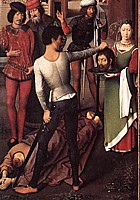 The
detail from the left panel of the St John Altarpiece painted
in 1474-79 by Memling (shown at right) is a good example of one
of the more accurate representations from the medieval period.
It is those kinds of works I am primarily concerned with here. The
detail from the left panel of the St John Altarpiece painted
in 1474-79 by Memling (shown at right) is a good example of one
of the more accurate representations from the medieval period.
It is those kinds of works I am primarily concerned with here.
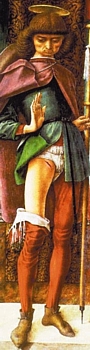
Paintings like the one at left (top of page) of a young man in
the stages of undress show how this particular outfit goes together.
The subject is lifelike and the colours, linings, lacings and
underwear are all painted similarly. Details like the wrinkles
at the knee where the hose is yet to be stretched upward and attached
and the wrinkling on the underpants where the string is lying
across the front, give the impression we can accept that a certain
standard of accuracy has been observed by the artist.
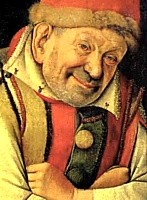 The
1442 Fouquet at left Portrait of the Ferrara Court Jester shows
very large buttons on the front of the bodice, but a closer inspection
shows that the garment was actually fastened with metal hook-and-eyes
which are identical to the ones still in use today. It is to these
painters and others like them that we can learn a great deal about
medieval clothing. The
1442 Fouquet at left Portrait of the Ferrara Court Jester shows
very large buttons on the front of the bodice, but a closer inspection
shows that the garment was actually fastened with metal hook-and-eyes
which are identical to the ones still in use today. It is to these
painters and others like them that we can learn a great deal about
medieval clothing.
Fabric
drape
As any art student knows, a large proportion of early study goes
into fabric, texture and drape. To make a modern comparison, a
satin formal dress will hang and drape in an altogether different
way to a woolen overcoat or cotton skirt. Linen pants will wrinkle
in a different way to jeans.
It is not enough to look at the seams and design without also
putting time and effort into finding out what kind of fabric was
likely to have been used for a particular garment being worn by
a particular class of person at a particular time of year. Looking
at the drape of the fabric will give an indication of the stiffness
of the fabric being depicted and may provide some clues.
As you would expect, the
quality of fabric would vary for different classes. Silk came
in many grades as did wool, which was easily produced by the lower
classes themselves. This in no way means that the upper classes
did not wear wool. It means that the quality of the wool being
worn was of a far superior quality and richness to that being
worn by merchants or peasants. 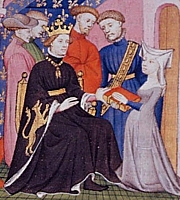
To make a modern comparison, the quality of a wool jumper bought
from Kmart for $20 is in no way the same quality as one from Chanel
for $400. Both the quality and tailoring would be of a different
standard altogether.
The image at right from 1410-11 of Christine Presenting Her
Manuscript To King Charles VI of France is an example of an
illustration which shows gathers and draping of fabric, especially
on the men's garments.
A
note on construction
I believe the tailoring of home made medieval clothing to be of
a better standard than generally supposed- with all sewing done
by hand, a relatively high standard of needlework would be achieved
by a girl of 12- the clothing produced for the wealthy would still
be of far superior tailoring.
Many historical re-enactors make the mistake of sewing rough clothing
for their portrayal of the lower classes. I believe that even
the poorest woman would have needed to make clothing as durable
and sturdy as possible to make the clothing last, and this would
not have been achieved with large uneven stitching or shoddy seams.
Even in art, the working class are shown with fabric wearing through,
not tearing at the seams.
As our clothing and fabric
choices vary with the seasons, it is important to remember that
those who lived in the Middle Ages would also have worn lighter
fabrics in the summer months and heavier ones in the winter. Not
all clothing would have been lined all year round. If decorum
dictated that several layers were to be worn by the upper classes,
then those layers may have been light.
In winter, more clothing would have been lined where the owner
could afford it. It is reasonable to say that some items of clothing
may have remained lined at any time of year- similar to
the way our jackets are never unlined. I would expect these to
be expensive, formal overgarments which make a feature of showing
off the linings with large sleeve openings like sideless surcotes.
I would expect that surcotes made for the working classes to remain
unlined and be of a more practical nature or lined with budget
furs.
Checking
sources
Care should also be taken not just to study where the seams do
and don't go, but to ensure that the artwork you are working from
is as close to a primary or secondary source as possible. A safe
rule of thumb for general wear is to find at least three of the
style garment before deciding it was widely worn.
A line drawing of a copy of an effigy, for example, may lose detail
each time it is redrawn. Black and white images also can be confusing
as to which line belongs to which layer, thus sometimes changing
the look of a garment entirely. 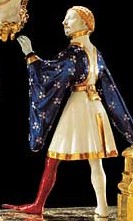
Remember, if you struggle to find many of the same kind of garment,
it probably isn't a good representation of common clothing worn
at that time.
The statuette at right shows
a very common style of men's clothing which is usually painted
one colour like the Gaston Phebus detail at left.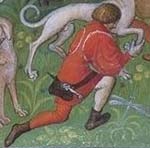 It could be supposed from paintings alone, that the curves at
the back are joining seams and the armholes are huge to allow
for freedom of movement during battle.
It could be supposed from paintings alone, that the curves at
the back are joining seams and the armholes are huge to allow
for freedom of movement during battle.
This colour version seems to indicate that instead of being the
Grand Asiette pattern (all sewn in one piece), the garment
may have been two garments, similar to the sideless surcote
which was popular with ladies. It appears that the cream fabric
is stiffer and thicker by far than the fine, draped sleeves, hinting
that instead of being one garment, it is in fact two layers of
different types of fabric. It may be that just the sleeves are
made of a different fabric. We can not tell for sure.
Fine
details
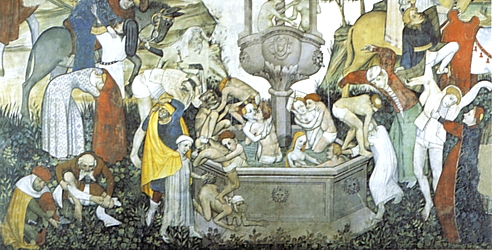
The fresco painted by Di Manta in approximately 1411-16, The
Fountain Of Youth (detail below) although depicting a mythical
event, goes into great detail showing people in various stages
of undress. Of the two chemises or smocks shown in this detail,
one is a thicker opaque material which drapes less (possibly a
linen and cut to a basic smock shape) and another is shown to
be very sheer with many pleats (possibly fine silk gathered onto
a neckline). These are both undergarments, both long and both
white, yet a quick glance will show that they are two very different
types of garment.
I do find the laced up kirtle
at the right side rather interesting as it seems to have a different
coloured bottom to the top yet be sewn together with a joining
seam at the waist and laced as one down the front with the spiral
style of lacing. As I haven't noticed that style of dress in any
other place, I feel it's possibly an undergarment with costlier
material on the top to show off expensive sleeves under an outer
garment and a less expensive fabric on the bottom where it can't
be seen. As this is the only one I've seen, I'd not recommend
it be used as a style guide.
Check
and double check
Among the many things to consider when doing research is the validity
of the work. Whilst many old books have fabulous information and
pictures, it is important to check modern thoughts, current ideas
and where the information comes from initially. If things don't
line up with consistancy or the sources are old, remember that
theyy were published with the current research known at that time,
which is not necessarily reflective of current knowledge
of finds and research.
There are a huge number of books on medieval costuming and it
must be remembered that to a large portion of the population,
medieval fantasy dresses and medieval fancy dress costumes are
one and the same as historical medieval clothing. Just because
the internet says it's medieval, it doesn't mean it is.
Paintings, manuscripts, monuments, effigies, statues and religious
icons are all great places to start clothing research and the
accessories that go with them. Books from museums and art catalogues
are invaluable as long as you take into consideration the reason
for the piece being made and the likelihood of it being an item
common enough for recreating.
Copyright
© Rosalie Gilbert
All text & photographs within this site are the property of
Rosalie Gilbert unless stated.
Art & artifact images remain the property of the owner.
Images and text may not be copied and used without permission.
|