|
beauty,
health &
hygiene
general
healthcare
skincare
cosmetics
& perfume
body
hair
cleanliness,
& hygiene tools
hair
care
hair
styles
oral
care
& dentistry
intimate
feminine
hygiene
|

Medieval
Cosmetics & Perfumes
FOUNDATION - EYELINER & EYESHADOW - LIP BALM
- ROUGE - PERFUME
Many debate the use of cosmetics
to enhance the female appearance during medieval times, but there
is a considerable amount of evidence for make-up during this period.
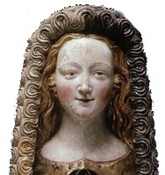
The statue at right is dated at 1350 and shows a well-made up
woman, her skin fashionably pale with plucked eyebrows, high hairline
and round forehead and a rosy glow which could not be due to anything
other than a generous amount of rouge. We could suspect that this
was just artistic endeavours to make an attractive sculpture,
but written records also support the use of cosmetics for the
medieval woman.
 Respectibility Respectibility
Opinions varied even between members of the clergy as to the respectability
of wearing cosmetics. It was felt that it was generally not a
desired state, although it was mentioned that women who had been
afflicted with illness and were thereby made unattractive, were
excused from the sin of vanity by using cosmetics.
The desire to not repel others or their husbands was deemed an
acceptable excuse for enhancement.
Thomas of Aquinas was questioned
about the use of cosmetics by woman and also grudgingly conceded
that for a woman to make herself as attractive as possible to
her husband so that he might not stray into the sin of adultery
was itself not a sin, however, it was cautioned that a woman should
not make herself so beautiful that she should attract other women's
husbands.
Foundation
Studies have shown that women in England 'painted their faces
white' to achieve a paler-looking complexion. Women often painted
their faces with blaunchet or wheaten flour or used lead-filled
cosmetics. It was assured that the root of the Madonna lily would
whiten the face.
Research also suggests ground lily root made a powder for faces,
although it does not specify what kind of lily was recommended.
The Compendium Anglicus from 1240 written by Gilbertus
Anglicus recommends cyclamen root.
One recipe for a flour-based
cosmetic to whiten the face comes from the L'ornement des Dames
in the 13th century. The method is as follows:
There is a white make-up
that is very easy to make. Put very pure wheat in water for
fifteen days, then grind and blend it in the water. Strain
through a cloth, and let it crystalise and evaporate. You
will obtain a make-up which will be as white as snow. When
you want to use it, mix it with rosewater, and spread it on
your face which has first been washed with warm water. Then
dry your face with a cloth.
 Eyeliner
and eyeshadow Eyeliner
and eyeshadow
Many books say that eyecolours and eyeliner were available during
the medieval period, and it is commonly known that since early
antiquity, Egyptians, Spainish women and later the woman of the
Rus at Staraya Ladoga in the 10th century were using eyeliner
and eyeshadow.
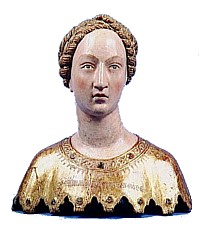
Paintings and sculptures for the High Middle Ages like the one
at left, show women with pale and unadorned eyes and eyebrows
heavily plucked.
It would seem, therefore, that although the technology to produce
eyeliner and eyeshadow was available, fashion dictated that it
wasn't used.
Lip
balms, lipsticks and stains
Lip tinctures and balms seem to be the lip treatments most commonly
referred to.
One recipe for a medieval
lip balm described as a 'sweet smelling grease that will keep
the lips and hands from chapping and make them moist and soft'
comes from the book Secrets of Don Alessio Piemontese,
published in 1557.
Take 12 oz of fresh
suet and 6oz of marjoram and pound them together. Form into
balls and sprinkle with good wine. Next put into some vessel
and seal it tightly so that the odor of the marjoram does
not escape. Place in the shade for 24 hours and then put into
water. Cook slowly, then strain. This process must be repeated
4 or 5 times always adding another 9oz of suet. Finally a
little musk or civet can be added.
There appeared also available
a lip stain in use, but I have no information about those at this
point.
 Rouge Rouge
The ground leaves of angelica, Angelica archangelica, were
the principal ingredient for the manufacture of 'ladies' red powder'.
Dried flowers of the safflower, Carthamum tinctorius, were
also used in the making of rouge. In a poem by a monk of Montaudon
from 1180-1215AD, the writer stated that the statues of the churches
complain to God:
'that there is not
enough paint left to adorn them because of all the ladies
who use rouge and cream.'
The Compendium Anglicus
from 1240 written by Gilbertus Anglicus, mentions brazilwood chips
soaked in rosewater would give a clear, pink dye which can be
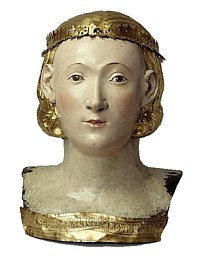
rubbed on the cheeks. Shown at right is the Bust of Saint Juliana
Circle of Giovanni di Bartolo dated 1375.
A 13th century French song described in Love Lock'd Out, A
Survey of Love, Licence and Restriction in the Middle Ages
by James Cleugh refers to a peddlar who carries for sale:
'razors, tweezers,
looking glasses, toothbrushes and tooth-picks, bandaus and
curling irons, ribbons, combs, mirrors, rosewater... cotton
with which they rouge themselves and whitening with which
they whiten themselves.'
showing the large range of
grooming cosmetics and tools which were in use and available at
the time.
Perfume
 The
idea that medieval women stank is just plain insulting. Women
were just as keen then, as now, to smell sweet and have pride
in their personal appearange. The
idea that medieval women stank is just plain insulting. Women
were just as keen then, as now, to smell sweet and have pride
in their personal appearange.
During the first crusade,
the crusaders came into contact with the 'heathens' and also with
their sweetly-scented and heavily-perfumed women. The crusaders
took back samples of these perfumes for their own women.
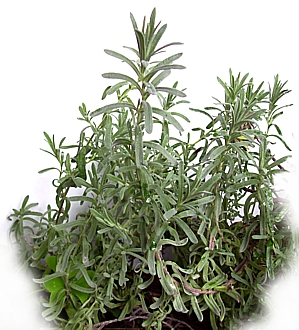
Roses and lavender, Lavendula
vera and Lavendula spica, were especially cultivated
for distillation of their oils in the medieval period as much
as they are today.
Roses and rose petals were used to sweeten a medieval women's
person. Trotula gives the following recipe for a scented powder
to brush into the hair:
But when she combs
her hair, let her have this powder. Take some dried roses,
clove, nutmeg, watercress and galangal. Let all these, powdered,
be mixed with rose water. With this water let her sprinkle
her hair and comb it with a comb dipped in this same water
so that [her hair] will smell better. And let her make furrows
in her hair and sprinkle on the above-mentioned powder, and
it will smell marvelously.
Myrtle was known and also
used in recipes for perfuming. Musk was known and used as a fixative
as was the extremely expensive ambergris which was imported.

Copyright
© Rosalie Gilbert
All text & photographs within this site are the property of
Rosalie Gilbert unless stated.
Art & artifact images remain the property of the owner.
Images and text may not be copied and used without permission.
|
