|

Medieval
Deaths, Funeral Rites & Rituals
MEMORIAL BRASSES - VIGILS & MASSES - THE BLACK
DEATH - BURIAL PROCEDURES - WIDOWS
 The
afterlife and the soul of the deceased was a very serious business
to those who lived and died in the Middle Ages and great consideration
was given into preparation for the soul's eternal life. The final
preparation of the body for burial was seen as just as important
as the life of the person who lived it. The
afterlife and the soul of the deceased was a very serious business
to those who lived and died in the Middle Ages and great consideration
was given into preparation for the soul's eternal life. The final
preparation of the body for burial was seen as just as important
as the life of the person who lived it.
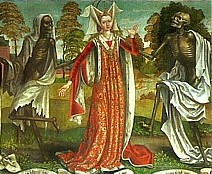
The detail shown at right is the Dance of Death by Talin,
of the mortality of man and the inability of even the upper classes
and kings to escape Death's clutches. The Dance of Death was a
popular theme in contemporary medieval artwork.
While death came to all,
its repercussions varied depending on the social stature of the
deceased.
When an unfree tenant passed away, a heriot or fine was
paid to his Lord; usually his best beast. It was written in the
Cuxham Court Roll that
'...even if he has only
a single animal, the Lord shall have it.'
The parish church claimed
the second-best beast as a mortuary fine. If a family was of modest
standing, it was quite possible to lose all the beasts it possessed,
especially if illness claimed more than one family member within
a short space of time.
Memorial
Brasses
Memorial brasses were a popular way for the wealthy to be remembered
after death, originating perhaps from the desire for memorials
more durable than the usual stone and marble slabs. 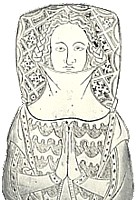 Brass
plates also offered the ability to record greater detail in clothing
and accessories than stone or marble. Brass
plates also offered the ability to record greater detail in clothing
and accessories than stone or marble.
The earliest existing dated examples of memorial brasses are from
the thirteenth century. The brass, an alloy of copper, zinc, lead
and tin was beaten into thick plates of various sizes and was
principally manufactured at Cologne and exported. England was
the largest consumer of brass for use in brass memorials.
Pictured at left, a memorial
brass of Elizabeth de Northwood dated at 1335. She is engraved
modestly wearing a wimple over her plaited hair which is resting
on an elaborate pillow.
Persons commemorated with brasses were usually engraved on the
plates life sized by deeply incised lines. Shading and minute
detail was not usually attempted. In some cases black and red
enamels were used to enhance the brass, while others brasses were
further adorned with Limoges enamels which could be many varied
colours.
Brasses were at their greatest artistic excellency in the 14th
century, slowly deteriorating in the following centuries. The
most popular pose for women was the hands pressed palms together
in devotional prayer. Often a couple were shown together and sometimes
a beloved pet was included at the feet.
Vigils
and Masses
Much expense was spent by the upper classes on candles, masses
and donations to the church. Funerals were not only to mark the
passing of a loved one, but for the nobility or very wealthy townsfolk,
it was another opportunity for a showy display of wealth. 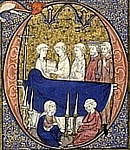
An elaborate funeral pall was often donated to the church to be
made into vestments or altar cloths afterwards and great sums
of money or lands donated to the church ensured prayers were said
for the soul of the departed.
Common people sat vigil with
the deceased, often singing, playing games and dicing. In an effort
to curtail these kinds of vigils which, in 1284, were felt by
the Ludlow church to be not particularly solemn, the guilds forbade
games and the attendance of women who were not direct family members.
Shown at right is a detail from the Murthly Hours, a 1310
illumination.
Guilds provided for their
own members even at the time of death with donations of masses,
tapers and burial costs, extending this to members of the guild
who lived outside of the town. It was standard practice that the
deceased would be afforded the same courtesies as if he had died
in his home parish.
 The
Black Death The
Black Death
The bubonic plague, known then as the Great Pestillance and now
as the Black Death, swept through Europe decimating populations
from 1347 to 1350 and again in 1399. It was widely believed by
rich and poor alike to be a punishment from God for the wickedness
of the people who lived indulgent lives at that time.
In actual fact, it is thought today that the plague was carried
by flea-infested rats. To the unlearned and educated alike, the
plague struck entire families down, randomly sparing a person
here and there. An estimated 25 million Europeans died.
Appointments to the church
were hastened to fill the urgent need for spiritual ministering
as the church also suffered losses among its numbers. As the numbers
of deaths grew and grew, mass graves were dug outside town walls
and last rites were not performed since there was no-one left
alive or willing to administer them.
Burial
Procedures
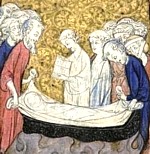
The body of the deceased was washed with water and then wound
in a white winding sheet or shroud in preparation for burial.
Illustrated above is a scene from the illumination The Murthly
Hours of 1310 showing a scene from a burial with the deceased
already wrapped in his winding sheet and being lowered into what
appears to be a casket of some kind while prayers are being read
from a book. Both women and men are in attendance.
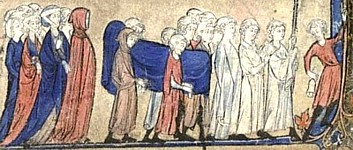 The
illumination at right shows another image from the same page of
The Murthly Hours manuscript of the funeral procession.
The procession is led by a person with a bell followed by monks,
then men, the deceased and finally by women. The funeral pall
is covering the deceased. The
illumination at right shows another image from the same page of
The Murthly Hours manuscript of the funeral procession.
The procession is led by a person with a bell followed by monks,
then men, the deceased and finally by women. The funeral pall
is covering the deceased.
Funeral palls were often
made of very costly material which was donated to the church afterwards
in return for masses for the departed's soul.
Rosemary, Rosmarinus officinalis, symbolic of memory and
fidelity, was used in wreaths for funerals.
Widows
The life of a widow often offered more opportunities than the
life of a married woman. In many cases, she was permitted to continue
her husband's business if she was previously trained in the trade.
She was then permitted to employ up to two apprentices and oversee
their training herself and confer guild status on her next husband
provided he worked at the same craft.
Listed in the records of The Company of Soapmakers of Bristol
are entries such as:
'The Wiiddowe Dies took
to prentice Michaell Pope the Son Richarde Pope of Bristeltowe
for the terme of VII yeares begininge the III of October 1593'
and also among the records...
'We reserved into the
fellowship of Sopmaken and changleng Richard Lemwell for that
he sarved his Apprentisshipe with Alice Lemwell wedow to sopemaken
and changlyng'
Register
of Rich Widows
A widow who was wealthy and of sufficient social standing naturally
attracted the attention of noblemen hoping to utilise her assets
to improve his own position. Widows of sufficient means or with
a large inheritance or with strategic land holdings might be put
under the king's 'protection'. The Register of Rich Widows
and Orphaned Heirs and Heiresses of 1185 shows that many were
married 'in the king's gift'.
Essentially, the king was within his right to grant the widow
in marriage to whomsoever he pleased.
It was possible for a widow to avert a match she wished to avoid
by buying her way out of such an agreement, however it was not
uncommon that the price to do so was extremely high and would
cost the widow the means to support herself afterwards, thus making
it impossible for a woman to free herself.
In many cases, it left her with little choice but to comply, unless
she took the mantle and the ring and became a vowess dedicating
her life to the service of God and promising to remain chaste.
Copyright
© Rosalie Gilbert
All text & photographs within this site are the property of
Rosalie Gilbert unless stated.
Art & artifact images remain the property of the owner.
Images and text may not be copied and used without permission.
|