|

Employment
- A Medieval Woman's Work
PEASANTS - TOWNSWOMEN - NOBLEWOMEN - OTHER WOMEN
 It
would be impossible to provide a comprehensive overview of women's
employment opportunities during the medieval period in full. I
have included a brief look at what women generally had the opportunity
to do, each according to her social status. It
would be impossible to provide a comprehensive overview of women's
employment opportunities during the medieval period in full. I
have included a brief look at what women generally had the opportunity
to do, each according to her social status.
This is by no means definite in every single case and there are
many records of women who worked outside the normal conventions
in occupations usually reserved for men alone.
Women are almost never shown
in paintings or manuscripts waiting on tables, a job far too important
to be entrusted to mere women. Serving food at a feast or to an
honored guest was highly esteemed and therefore a job which belonged
to the head Steward of a house- a man. In a poorer household,
of course, the women of the house would have brought food to the
table for her husband and family.
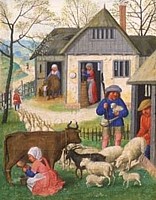
Shown at top right is a detail
from the month of April from the da Costa Book of Hours
illustrated in 1515 by Bening. It shows a domestic scene where
men and women work together at a variety of menial jobs- milking
the cows, tending the sheep and churning butter.
 Peasant
and rural women Peasant
and rural women
Peasant women were usually employed in menial work outside the
home as well as raising their own family, taking care of their
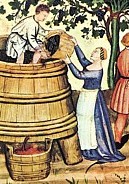
own vegetable patch and any poultry they may have had. Shown below
is scene from the Tacuinum Sanatatis showing women working
with men in a rural setting.
Young, single English peasant
women rarely had the capital to go into business for themselves
brewing or baking. They were often employed as live-in servants
although recent studies have shown that it was a very poor peasant
who could not afford help of her own.
Girls might have worked for a neighbour, relative or be engaged
in household work in the nearest town. Working as a servant was
not seen as a demeaning work choice and occasionally in household
rolls, children are described as being servants of their own parents.
With only the very poorest peasant women unable to afford some
domestic help, there was usually no class difference between mistress
and maid.
A woman's status came from her being a wife, rather than where
she was employed.
Once married, it was usual
for a women to give up her service to someone else and be mistress
of her own home. Rural women were also engaged in spinning and
preparation of fibres for spinning and weaving- scouring flax,
combing wool and hemp and assisting with sheep shearing.
There was very little that
a peasant woman might not be called to do and many illuminations
show women working in the fields alongside men. 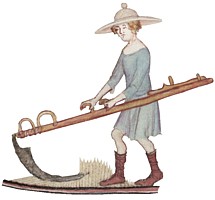 They
were hired to do various types of agricultural labour, including
planting peas and beans, weeding, reaping, binding, thatching,
haymaking, hay stacking, threshing and winnowing. They
were hired to do various types of agricultural labour, including
planting peas and beans, weeding, reaping, binding, thatching,
haymaking, hay stacking, threshing and winnowing.
Of the two work options,
live-in servitude was a more secure place of employment and the
wages were slightly higher than seasonal work. Outdoor work was
usually, but not in all cases, paid at a rate slightly less than
men, although women thatchers and reapers were often paid at the
same rate as their male coworkers.
The Statute of Cambridge in 1388 shows that the maximum
wage for women laborers and dairymaids was 6 shillings per year,
much less than the top wage of 10 shillings.
Shown at right is a detail from a border decoration from the Romance
of Alexander dated between 1338 and 1344. It depicts a peasant
woman working in the fields and using the same equipment that
a men would also have used. The picture is slightly unusual in
that the woman is wearing a short dress and her legs are visible.
 Townswomen,
urban & middle class women Townswomen,
urban & middle class women
Women who lived in towns, were middle class or were engaged in
some kind of merchant activity were better off than their counterparts
in the country, although it it not to be thought that the hours
they worked were any less. As well as a full time job, townswomen
also had a family to care for and a small household to run and
probably one or two staff of her own to manage.
Many townswomen were women who had previously lived in the country
and had moved a nearby town seeking full-time employment. This
was not seen as a lifetime occupation, but rather an employment
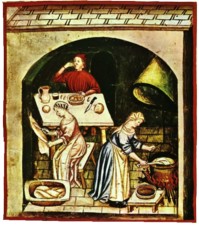
option suitable for single women until marriage. Shown at left
is a detail from the Tacuinum Sanitatus showing middle
class women working in the home.
 Many
women were shopkeepers and wage earners. A women whose husband
had died, may have continued his trade alone as a femme solo,
and be authorised to hire apprentices to carry on her husband's
work. Some women were permitted into Guilds but in many cases
they were not admitted solely because of their gender and not
because of lack of skill or experience. Very few women were formally
apprenticed, although many were trained in trades informally.
Wives and daughters of skilled tradesmen often fell into this
category. Many
women were shopkeepers and wage earners. A women whose husband
had died, may have continued his trade alone as a femme solo,
and be authorised to hire apprentices to carry on her husband's
work. Some women were permitted into Guilds but in many cases
they were not admitted solely because of their gender and not
because of lack of skill or experience. Very few women were formally
apprenticed, although many were trained in trades informally.
Wives and daughters of skilled tradesmen often fell into this
category.
Records of women who worked
in towns include, but are not limited to, the following occupations:
hat-making, cobbling, glover-making, girdle-making, haberdashery,
embroidering, purse-making, cap knitting, spinning and silk weaving.
They were involved in the food industry in the areas of brewing
of ale, butchery, innkeeping, selling garlic, fresh bread, flour,
salt, candles, butter, cheese, fish and poultry.
While many of the textile arts were dominated by men, embroidery
seems to have a larger percentage of women workers than other
guilds. Records from the very end of the 13th century show that
of the 94 registered embroiderers in Paris, 79 were women.
It may come as a surprise
to some that women were also employed as chandeliers, iron mongers,
smiths, goldsmiths, skinners, bookbinders, painters, spicers and
farriers. Possibly these were widows who were able to carry on
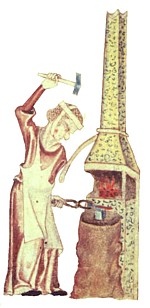
their husband's trade. Shown at right is a woman blacksmith or
farrier at work from the Holstein Bible from the 1330s.
Noble
and upper class women
There are many misconceptions attached to the noble woman, and
how she spent her days. In reality, a woman in the upper classes
might not be called upon to do hard, manual labor, but she was
in no way exempt from a busy, managerial role.
 An
upper class woman was almost always a land owner, inherited as
part of her dowry at marriage. As well as her own holdings, a
wife had to be able to replace her husband during his absences.
Considering the number of wars and crusades which occurred during
the medieval period, these absences could be frequent and lengthy. An
upper class woman was almost always a land owner, inherited as
part of her dowry at marriage. As well as her own holdings, a
wife had to be able to replace her husband during his absences.
Considering the number of wars and crusades which occurred during
the medieval period, these absences could be frequent and lengthy.
The lady of the manor oversaw production of the home farm and
dairy. She had to be able to govern the house and hire or fire
the staff who worked under her and know enough about the work
being done to recognise if it was being done well, even if she
was not actually doing the work personally. She also needed to
know how to hire seasonal staff and repairmen and pay them fairly.
Records indicate that a noble woman could, and did, draw up wills,
sue and be sued and make contracts.
Even in a large manor, several
small rooms or cottages accommodated the production of consumable
goods for the estate or the immediate household, its staff and
its guests; all of which required overseeing. A noble lady also
needed good accounting and reckoning skills and was often literate.
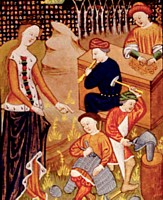
The detail at left shows an illumination from a 15th century manuscript
by Boccaccio known as the de Claris Mulieribus showing
Minerva in a supervisory role instructing the making of armour.
Other
Women
 Other
occupations provided important livelihoods for medieval women,
and these included a life of religious devotion, healthcare, musician
or prostitution. Other
occupations provided important livelihoods for medieval women,
and these included a life of religious devotion, healthcare, musician
or prostitution.
Women who wished to avoid
marriage or were widowed and wished to avoid further marriages
had the opportunity to take a life of religious contemplation.
This came in many forms, but almost all involved life in a community
under the care of an Abbess.
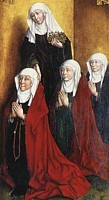
Beguines were religious women who lived simple lives and were
known for their charitable works. Many of these women were from
the middle or upper classes. Shown at right is a scene from the
right of the Adelheere Altarpiece from 1443.
Other opportunities for women
were to train as healers or midwives. Doctors were needed in towns
of every size and it seems that midwifery was almost an exclusively
female domain. Nurses might have attend the new mother and cared
for the newborn, or worked in a hospital or hospice caring for
the sick, diseased or pilgrims who were en route to a shrine and
had fallen unwell along the way.
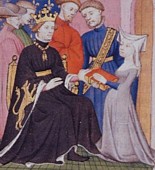 Occasionally
we hear of an exceptional woman who took a profession uncommon
to most other women. One such famous medieval woman was Christine
de Pisan who, as a widowed mother of three, and only aged 25,
became a successful writer to support herself and her family. Occasionally
we hear of an exceptional woman who took a profession uncommon
to most other women. One such famous medieval woman was Christine
de Pisan who, as a widowed mother of three, and only aged 25,
became a successful writer to support herself and her family.
Although women did write, it was not a usual career path for most
women. The illumination detail at left shows Christine Presenting
Her Manuscript To King Charles VI of France. It is dated at
1410-1411.
Women who were outside of
the normal roles for medieval women might also be employed as
musicians- jongleuresses and menestrelles. They
usually traveled as part a of small groups of entertainers and
were often the wives or daughters to their male counterparts.
In a few cases, there are records of women in independent roles.
In 1321 in Paris, women were given permission to participate in
the Guild of Minstrels.
Prostitution, as much as
it was frowned upon, was deemed a rather necessary part of life,
and poor women sometimes turned to this in order to make a living.
Towns and cities tried to regulate the clothing a prostitute could
wear and sumptuary laws tried to curtail extravagant clothes which
the lifestyle of a working woman could afford.
Copyright
© Rosalie Gilbert
All text & photographs within this site are the property of
Rosalie Gilbert unless stated.
Art & artifact images remain the property of the owner.
Images and text may not be copied and used without permission.
|