General
Medieval Healthcare
HEADACHES - WEIGHT LOSS - WORMS - WARTS &
CORNS - MOSQUITO REPELLENTS
BODY ODOUR - ANTISEPTICS - TOILET PAPER
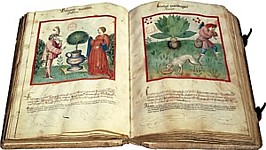
Perhaps the best-known medieval
medical journal is the late 14th century Tacuinum Sanitatis,
shown above, which was a medical codex with almost full-page,
colour illuminations. There are several existing copies of this
book which vary slightly, but contain, for the most part, the
same information.
One copy was written and illuminated for the Cerruti Family and
was probably made from Verona. The Tacuinum Sanitatis dealt
with many aspects of healthcare- herbs, substances, emotions and
types of fabrics. It tell of the benefits and dangers of each
and what to do about them. 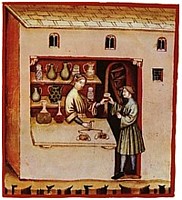 Much
of what we know today about medieval healthcare comes from these
manuscripts. Much
of what we know today about medieval healthcare comes from these
manuscripts.
The detail at left, is from
the Tacuinum Sanitatis and shows a man purchasing medicine
from an apocathary. The scales on the bench were used to give
correct measure for many of the complicated recipes used.
Only a few textbooks survive
specifically dealing with women's health, although it must be
supposed that medieval women faced the same kind of daily complaints
as the modern woman.
Headaches, ringworm and warts were seen as curses from a displeased
God, but home remedies went hand in hand with prayers for the
cure of many ailments.
 Icons Icons
Religious items were genuinely believed to aide with many aspects
of healthcare- whether relief for a mother in labour or for assistance
with plague. Looking at an image of Saint Christopher was devoutly
believed to give protection from sudden death for the next 24
hours.
Wearing a ring or brooch with the names of the three wise men-
Caspar (or Jaspar), Melchior and Balthazar-
was also good to epilepsy preventative.
Reliquaries, which held a small piece of religious artifact, were
a guaranteed recipe for good health and protection from sickness.
The Lamb of God reliquary from the Gilbert Collection,
seen at right, would have held a small piece of holy artifact
or a small item blessed with holy water.
Many 13th and 14th century rings were also inscribed with the
letters A.G.L.A. which were to aid against fevers.
Treatices
& books
Hildegard von Bingham, a twelfth century German woman physician,
wrote on women's health, as did Gilbert the Englishman in the
13th century. His compilation of remedies are based on a Latin
medical textbook and is known as The Sickness of Women.
The Tacunimum Sanitatus had an extensive list of natural herbs,
foods and plants and what they were good for.
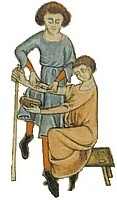 Bloodletting
was believed to release vile humours from the body through the
wound and was widely practiced on both men and women. The picture
at left is a detail form the 14th century illumination, the Luttrell
Psalter and shows a doctor releasing blood from an ailing
patient. Bloodletting
was believed to release vile humours from the body through the
wound and was widely practiced on both men and women. The picture
at left is a detail form the 14th century illumination, the Luttrell
Psalter and shows a doctor releasing blood from an ailing
patient.
Many herbal remedies were
utilised throughout the Middle Ages, some of which persist today.
Taking honey for a sore throat in these modern times certainly
does not raise any eyebrows and was a common remedy in the middle
ages. Listed below are home herbal preparations recorded for use
from as early as the 12th century.
Please don't try these at home. They made be injurious or inflict
harm.
DO
NOT TRY THESE AT HOME!
Headaches
It is written in Culpepper's Herbal, that vervain, Verbena
officinalis, warded off headaches, although it it not specified
how. A 15th century recipe for relief of the migraine gives more
thorough instructions;
..take half a dish of
barley, one handful each of betony, vervain and other herbs
that are good for the head, and when they be well-boiled together,
take them up and wrap them in a cloth and lay them to the sick
head and it shall be whole...
Weight
loss
 It
seems that as now, the medieval woman could be concerned with
her weight. It
seems that as now, the medieval woman could be concerned with
her weight.
One did not wish to be thin, as this indicated the lack
of means to feed oneself properly, however after childbirth or
when weight became greater than desired, slimming tonics were
called for.
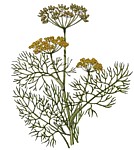
To enhance loss of weight, fennel, Foeniculum vulgare, at
right, seeds are reputed to make people lean that are too fat.
Garden patience or Great monk's rhubarb roots were also used in
diet drinks.
 Worms Worms
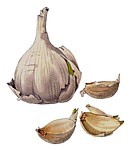
Garlic, Allium sativum, at left, was eaten whole like a
vegetable. Warm and dried, it was given against poisons but also
to kill worms while onion, Allium cepa, steeped all night
in springwater kills worms if taken after morning fasting.
Another cure is made thus:
Take lime and twice as
much chalk and with wine or water, make a thin cement. Apply with
5 days with a feather to the area where the worm is. On the fifth
day, take aloe and a third as much myrrh, crush and with fresh
wax, prepare a plaster. Use hemp cloth and tie on for 12 days.
Warts
and corns tinctures
The sun dew juice unmixed and applied topically will destroy warts
and corns. Spurge or garden spurge milk is good to take away warts
if applied externally.
Mosquito
repellents
Pennyroyal, Mentha pulegium, was popular as a flea dispeller
scattered or burnt in rooms, and the leaves were rubbed on the
skin to deter insects.
Deodorant
The texts attributed to Trotula offer a remedy for body odour
for women. It says this:
There are some women
who have sweat that stinks beyond measure. For these we prepare
a cloth dipped in wine in which there have been boiled leaves
of bilberry, or the herb itself or the bilberries themselves.
Antiseptics
 Marshmallow,
Althaea officinalis; Ivy, Hedera helix and Thorn
apple, Datura stramonium were still used in twentieth century
rural England to soothe injuries, burns and insect bites and have
been handed down for generations as herbal remedies. Marshmallow,
Althaea officinalis; Ivy, Hedera helix and Thorn
apple, Datura stramonium were still used in twentieth century
rural England to soothe injuries, burns and insect bites and have
been handed down for generations as herbal remedies.
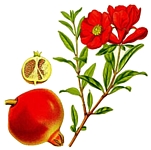
Alum and pomegranate, Punica granata, at right, are mentioned
by Roger of Frugard as ingredients in a lotion to overcome suppuration,
and are astringents.
Banckes' Herbal written
in 1525 suggests Rosemary, Rosmarinus officinalis as a
medieval antiseptic writing:
boil the leaves in white
wine and wash thy face therewith, thy beard and thy brows, and
there shall no corns grow out, but thou shall have a fair face.
 Toilet
paper Toilet
paper
Although toilet paper- squares made from rice paper which was
cheap and plentiful- was known in China as early as the 6th century,
it was noted with horror that the Chinese only wiped and not washed
with water as other Europeans did.
It seems that toilet paper,
and indeed the idea of toilet paper, was unappealing to
early Europeans and the use of paper squares was not adopted back
home.
Obviously, some kind of wiping
system or device was used during the middle ages. There appear
to be two that we know of today- gomphus or the gomph
stick and torchcut or torche-cul.
The gomph stick was a curved
stick and used as we use toilet paper- to scrape.
The torche-cul refers to
straw which was used in the toilet. It literally translates as
'arse-wipe' or 'arse-torch' indicating that the straw was used
either for lighting in the toilet or as a substance to wipe with.
Some people assert that Spaghnum moss was used to wipe
with and while we don't know for sure, we find its presence in
cess pits. The manuscript image to the right (source unknown)
shows an outdoor privvy with two seats and a supply of what might
be straw in the rack above.
Perhaps water was supplied
for washing down below as well as for the hands and face, but
if so, it is not mentioned anywhere I've seen to date.

Copyright
© Rosalie Gilbert
All text & photographs within this site are the property of
Rosalie Gilbert unless stated.
Art & artifact images remain the property of the owner.
Images and text may not be copied and used without permission.
|