|
clothes
&
accessories
items
of
clothing
cotes
& tunics
kirtles
surcotes
houppelands
15th
century
gowns
maternity
wear
cloaks
& mantles
corsets
underwear
chemises
bras & bust
support
underpants
hose &
garters
sleepwear
chemises
bras & bust
support
underpants
hose &
garters
|

Medieval
Maternity Wear
Clothes for Pregnancy & Breastfeeding
 It
seems that expectant medieval women favoured clothing much like
modern pregnant women- loose and comfortable. It is a subject
not written about greatly, so in this area, we are left to examine
period artwork for our information. It
seems that expectant medieval women favoured clothing much like
modern pregnant women- loose and comfortable. It is a subject
not written about greatly, so in this area, we are left to examine
period artwork for our information.
Clothes
for pregnancy
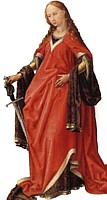
At right, the 1440 painting from the right panel of a diptych
by Rogier van der Weyden shows a heavily pregnant woman in a voluminous
surcote covering her stomach.
Even though the depiction of a sword held by the subject marks
this painting as clearly not a portrait, the reasonably accurate
features leads us to believe that the clothing is not fantasy
and is of the type that may have been worn by a pregnant woman.
She appears to be wearing at least 2 more gowns underneath- a
kirtle with fitted sleeves and another loose gown with hanging
sleeves which were popular in the 15th century. It is quite likely
that her kirtle is laced open to accomodate her expanding figure.
Importantly, we cannot see this, as the kirtle is covered by further
layers.
 One
of the most commonly depicted pregnancy scenes in medieval art
is that of Mary and Elizabeth, both of whom are heavily with child.
The paintings usually show the two women with a hand resting on
the other woman's stomach. One
of the most commonly depicted pregnancy scenes in medieval art
is that of Mary and Elizabeth, both of whom are heavily with child.
The paintings usually show the two women with a hand resting on
the other woman's stomach.
Even in late iconography, both women usually wear a surcote which
is large and gathers onto a neckband. This style can be seen in
the early medieval period as an everyday dress before the fitted
kirtle was introduced.
 Often
the loose over gown was worn with a tie knotted under the bust
which seems to be omitted when the woman is pregnant. Often
the loose over gown was worn with a tie knotted under the bust
which seems to be omitted when the woman is pregnant.
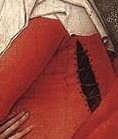
In the 1445 painting The Visitation by van der Weyden,
shown at left, we also note a red gown with side lacing which
is expanded to accommodate a growing figure.
The close-up detail at right shows that the spiral side lacing.
This would still permit a fairly form-fitting gown which could
be tightened after a woman regained her usual body shape.
At a time where clothing was less disposable and more highly valued,
a multipurpose gown like this would be a practical solution to
the frequent pregnancies faced by medieval women.
Clothes
for breastfeeding
 Contemporary
images of medieval women breastfeeding are next to impossible
to find. Most noble women didn't breastfeed their own babies,
prefering to utilise a wet nurse, and on the whole, no one was
interested enough in the common woman breatsfeeding to bother
painting her. Contemporary
images of medieval women breastfeeding are next to impossible
to find. Most noble women didn't breastfeed their own babies,
prefering to utilise a wet nurse, and on the whole, no one was
interested enough in the common woman breatsfeeding to bother
painting her.
Fortunately for modern scholars and, we do have an extremely large
number of paintings which show breastfeeding. Those of the Virgin
Mary.
 Some
show the overdress pulled awkwardly to the side or downwards,
but other mothers appear to favour front-lacing gowns for what
must have been practical reasons. Some
show the overdress pulled awkwardly to the side or downwards,
but other mothers appear to favour front-lacing gowns for what
must have been practical reasons.
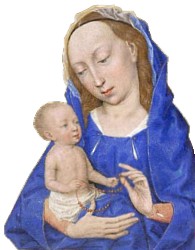
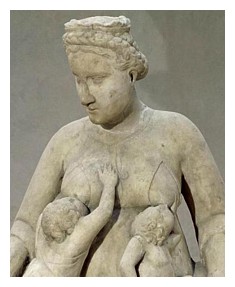
An image from the South Netherlands, Bruges or France (probably
Valenciennes) dated between 1485 -1490, shows a gown with two
buttons which would allow access to the breast for easy breastfeeding.
This is quite similar to
other images of the Virgin with two fichets, that is, slits, high
in her gown over the breasts which allow the breast to be utilised
at a more natural position. They are clearly seen at left in the
sculpture of Charity dated between 1300 to 1325 by Tino de Camaino
of Florence.

Copyright
© Rosalie Gilbert
All text & photographs within this site are the property of
Rosalie Gilbert unless stated.
Art & artifact images remain the property of the owner.
Images and text may not be copied and used without permission.
|
