|

beauty,
health &
hygiene
general
healthcare
skincare
cosmetics
& perfumes
body
hair
cleanliness
& hygiene tools
bathing
hair
care
hair
styles
oral
care
& dentistry
intimate
feminine
hygiene
|

Oral
Care & Medieval Dentistry
BREATH FRESHENER - TOOTH WHITENING - TOOTHACHE REMEDIES
TOOTH DECAY - DENTISTRY - DENTURES
Teeth in the medieval period
were perhaps not as bad as Hollywood would have us believe. Brushes
used for the specific cleansing of the teeth appear to be unknown
although sticks for picking at food left between the teeth were
widely used. Teeth still broke, got cavities and ulcers but decay
from refined, processed sugars were significantly less than today.
Breath
freshener
Ladies who were troubled with bad breath were advised to employ
the use of anise, fennell and cinnamon as remedies. To chew on
the leaves should alleviate the situation much in the same way
that parsley is served on our plates today- not just a garnish,
but also to remove any bad breath caused by odorous foods.
Whole bruised cloves syzygium aromaticum, shown at right,
held in the mouth also sweetened the breath. Mouthwashes of vinegar
along with various powders and the leaves of the mallow plant
were employed to keep the breath sweet.
Other remedies include gargling birch and mint soaked in wine
and rubbing the gums with a strong linen cloth until they bleed.
Sage with rosemary and mallow is suggested to help with soreness
of the mouth and along with salt and vinegar to ward off mouth
cancer.
Hildegarde von Bingham, 1158,
recommends this mouthwash and breath freshener-
One who wishes to have
hard, healthy teeth should take pure, cold water into his mouth
in the morning, when he gets out of bed. He should hold it for
a little while in his mouth so that the mucus around his teeth
become soft, and so this water might wash his teeth. If he does
this often, the mucus around his teeth will not increase, and
his teeth will remain healthy. Since the mucus adheres to the
teeth during sleep, when the person rises from sleep he should
clean them with cold water, which cleans teeth better than warm
water. Warm water makes them more fragile.
Tooth
whitening
Many herbal preparations were used to cleanse the teeth and preserve
whiteness. The ashes of the burnt vine-tree or grapevine were
thought to make teeth that are as black as coal to be as white
as snow if you rub them every morning.
Trotula de Ruggiero, a woman physician from the 11th century,
wrote in De Ornatu Mulierum (About Women’s Cosmetics)-
 The
teeth are whitened thus. Take burnt white marble and burnt date
pits and white natron, a red tile, salt, and pumice. From all
of these make a powder in which damp wool has been wrapped in
a fine linen cloth. Rub the teeth inside and out. The
teeth are whitened thus. Take burnt white marble and burnt date
pits and white natron, a red tile, salt, and pumice. From all
of these make a powder in which damp wool has been wrapped in
a fine linen cloth. Rub the teeth inside and out.
The woman should wash her mouth after dinner with very good
wine. Then she ought to dry very well and wipe with a new white
cloth. Finally, let her chew each day fennel or lovage or parsley,
which is better to chew because it gives off a good smell and
cleans good gums and makes the teeth very white.
Other recipes for teeth whitening
include herb elecampane inula helenium to scrub the teeth,
or making a powder of sage leaves and salt.
A prescription for a tooth powder follows:
equal parts of cuttle
bone, small white seashells, pumice stone, burnt stag's horn,
nitre, alum, rock salt, burnt roots of iris, aristolochia, and
reeds. All of these substances should be carefully reduced to
powder and then mixed.
Toothache
remedies
Toothache was seen as a punishment from God for the sufferers
ill-doings or caused by worms burrowing into the gums and teeth.
Roger Frugard's treatise, which was written in latin in Italy
around 1180AD, suggests cauterising the skin behind the ears before
heating henbane Hyoscyamus niger and leek seeds over hot
coals and ensuring the patient inhales the smoke through a funnel.
As late as 1314, praying to St Apollonia on her feast day of February
9th was still recommended as a cure. 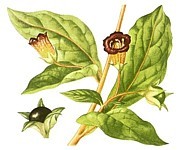
Welsh sources indicate the
use of nightshade, Solanum nigrum , shown at right, although
not in what form. Pellitory, anacyclus pyrethum was also
used against bad breath, toothache and caries, as were opium,
papaver somniferum and oil of cloves caryophyllus aromaticus.
A marginal note in the Lebar
Brecc from the Revue Celtique V, edited and translated
by Whitley Stokes gives us this prayer to heal his toothache:
Ordu Thomais togaide
i toeb Crist cen chinaid
ron-ícca mo déta cen guba ar chruma is ar idhain.
(translation: May the thumb of chosen Thomas in the side of
guiltless Christ
heal my teeth without lamentation)
Tooth
decay
The lack of refined sugars that we know today assisted in less
instances of tooth decay, although poor nutrition caused its own
set of problems. It was believed that a decoction of the husks
of Cayenne Pepper or Guinea Pepper made with water preserved the
teeth from rottenness and the ashes of them being rubbed on the
teeth will cleanse them and make them look white.
The blackened teeth we popularly see in movies when the middle
ages are portrayed, is a product of Victorian imaginations, whose
excessive sugar consumption caused tooth decay. Cooking in the
middle ages used only a little sugar, like a spice. Honey was
used as a sweetener, and clean teeth were valued over rotten ones.
There are records of acid being employed to pour into painful
tooth cavities which destroyed the nerve endings and alleviated
the pain but did nothing to re-enforce the tooth shell.
Material used for early fillings include sulphur, camphor, beeswax,
arsenic, gall nuts, pig grease and myrrh.
Dentistry
For the lay populace dentistry was quite rudimentary and often
extractions were performed by itinerants who traveled from town
to town. One advises:
Take some newts, by
some called lizards, and those nasty beetles which are found
in fens during the summer time, calcine them in an iron pot
and make a powder thereof. Wet the forefinger of the right hand,
insert it in the powder, and apply it to the tooth frequently,
refraining from spitting it off, when the tooth will fall away
without pain. It is proven.
 The
wealthy often were afforded better and more specialised dental
care. During the Middle Ages, a sponge with White Poppy papever
somniferum juice, mandrake, hemlock and ivy was used as a
form of anesthetic and it is possible that this was used by dentists. The
wealthy often were afforded better and more specialised dental
care. During the Middle Ages, a sponge with White Poppy papever
somniferum juice, mandrake, hemlock and ivy was used as a
form of anesthetic and it is possible that this was used by dentists.
Post extraction bleeding and infection often caused problems.
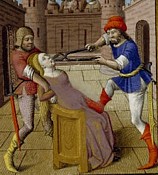
The image at right is a detail from a French illumination from
1470 showing a tooth extraction.
Roger Frugard's text discusses
oral cancer and recommends that in the acute stages it can be
cured by cutting into the normal flesh around the cancer, cauterizing
the wound and then sealing it with egg yolk before washing it
with wine. After three days the wound should be rubbed with alum
before applying a lotion made from wine and honey and infused
with the roots of the herb Mullein, Honeysuckle, Pomegranate and
Ginger.
Guy de Chauliac's text lists
the items which a dentist should have. They include:
mouth washes, gargles,
masticatories, anointments, rubbings, fumigations, cauterizations,
fillings, filings, and the various manual operations and must
be provided with the appropriate instruments: scrapers, rasps,
straight and curved spatumina, elevators, simple and with two
branches, small sealpels, tooth trephines, files, toothed tenacula,
and many probes.
He recognized the presence
of tartar which he called hardened limosity or limyness.
He suggested the use of rasps and spatumina as a means of manually
removing the tartar.
Dentures
Guy de Chauliac refers to false teeth made from 'oþer
menis teeþ or of a kowes bone', the bones of a cow.
If teeth loosen, he advises they be fastened to healthy ones with
a gold chain. If the teeth fall out, they may be replaced by the
teeth of another person or with artificial teeth made from oxbone,
which may be fixed in place by a fine metal ligature. He says
that such teeth may be serviceable for a long while.
Paul B Newman, author of Daily Life In The Middle Ages
claims that gold caps were used as early as the 15th century.
A paper published in the British Dental Journal shows that some
12-14th century literature makes reference to creating false teeth.
A lecture given to the PHS in May 1993 by Dr David Brown, Head
of the Department of Dental Materials Science, U.M.D.S. Dental
School, Guys Hospital, London stated that:
Historically, a range
of materials has been used for denture bases, including stone,
wood, shell, bone, horn, ivory and metal. The Romans used bone
and ivory (from the hippopotamus) including natural teeth in
the dentures then subsequently ivory and later porcelain teeth.
There appear to be no records of this technology being used
in the middle ages however, so it is unknown whether these methods
were known and employed or otherwise.
Johanues Arculanus, a professor
of medicine and surgery at Bologna from 1412 to 1427 is the first
we know who mentions the filling of teeth with gold.

Copyright
© Rosalie Gilbert
All text & photographs within this site are the property of
Rosalie Gilbert unless stated.
Art & artifact images remain the property of the owner.
Images and text may not be copied and used without permission.
|
