|
fabrics
& sewing
sewing
tools
sewing
techniques
basic
medieval
clothing
sewing
tutorials
commercial
patterns &
what to do
about them
dyes
&
colours
fabric,
fur
& leather
names
embellishments
& embroidery
buttons
& lacings
|

Bought
Patterns
... and what to do about them.
Many commercial patterns are available but most of these are a
mixture of time periods designed to appeal the the Renaissance-fantasy
crowd.
 Many,
many commercial patterns are available but most of these are a
mixture of time periods designed to appeal the the Renaissance-fantasy-goth
crowd. They are usually not even close to providing a decent
medieval pattern and they are harder and more complicated to make
than an actual medieval pattern. Remember, just because it has
the word "medieval" on the packet, doesn't mean it is. Many,
many commercial patterns are available but most of these are a
mixture of time periods designed to appeal the the Renaissance-fantasy-goth
crowd. They are usually not even close to providing a decent
medieval pattern and they are harder and more complicated to make
than an actual medieval pattern. Remember, just because it has
the word "medieval" on the packet, doesn't mean it is.
Modifications of almost ALL of the patterns below ARE NECESSARY
for reasonably authentic results! They are included here only
as a starting point for sewers.
If you're a historical re-enactor, you might want to try PERIOD
PATTERNS or RECONSTRUCTING
HISTORY which you'll need to buy online and have shipped to
Australia.
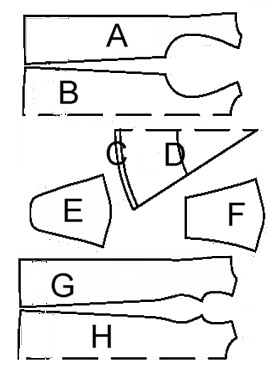
So what's a medieval dress supposed to look like?
There are a few styles, but one of the easiest is the 4-panel
dress. There's a seam at the front and back in the centre and
a seam up each side. There are set in sleeves with a seam that
runs three-quarters around the back of the arm (if you have a
suit jacket, go look at the sleeves and you'll see what I mean).
It can have triangles inserted into the bottom of the seams in
the body of the dress to make the skirt part fuller. It can lace
or have buttons at the front and can have buttons all the way
up the sleeve. You can wear a dangly arm wrap called a tippet
with it.
A lot of old school patterns for sundresses have the same 4-panel
construction and and can be lengthened to make a decent sort of
dress.
Please remember that
even a bought pattern will need to be tried on
and pinned to your own body shape for the best results!
Gowns,
kirtles and tunics
Ladies Dress and
Surcote
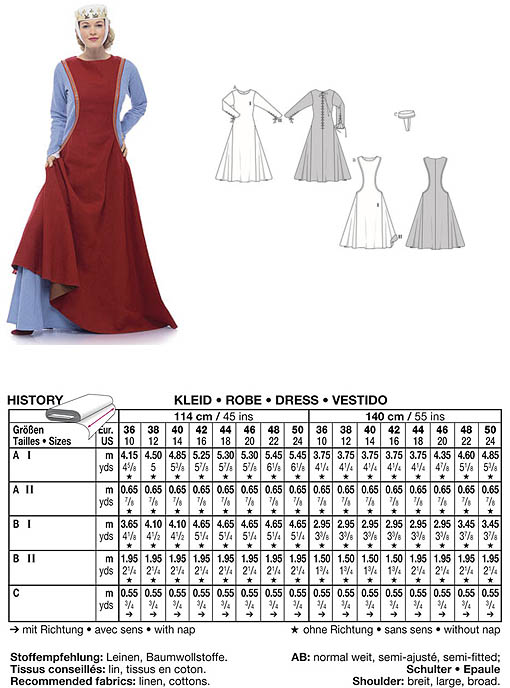
Burda 7977
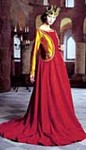
I've included a big picture here because it's a pattern
that's pretty much got it right. Ladies, it comes in all
sizes and really does look like the one pictures here.
Historically, it's pretty much put together right and
you'll look great. If you don't want the lacing (which
can be at the back or front) just sew that seam up. Most
medieval dresses buttoned up the sleeves. This pattern
can be bought from Spotlight and is my favourite commercial
pattern.
|
 |
 |
Men's
and Ladies Basic Tunics
Simplicity 8108
Avoid the over-the-shoulder sash and the Roman. The others
are a pretty good basic pattern. For the men, the tunic can
be made long, short or anywhere in between. For the women,
a round or T neckline can be decorated with embroidery or
braid. Extra triangles of fabric can to put into the bottom
hem seams to make the skirt wider. The dress will pull on
over the head and be pulled in with a belt (either thin leather
or fabric). |
|
|
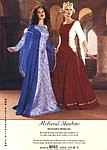
Dress
with small hanging sleeve, Sideless surcote
McCalls 3653
Do NOT use the blue dress. The outfit on the right is okay.
The cream underdress should actually be two seperate dresses
and not one dress with a fake undersleeve, but in the interests
of keeping it simple, it's not too bad. It would lace at
the back or pull on over the head.
The red surcote would be worn over a dress with plain sleeves
and doesn't need the lacing at the sides or trim around
the bottom.
|
|
|
Kirtle
with Sideless Surcote
Simplicity 8725
I have this pattern. The basic gown or kirtle used a massive
amount of fabric (approx 8m) for the dress alone. Sleeves
are excellent. The low, wide neckline is nice. I'm really
not too convinced about the placement of actual seams on this
one but it's better than most. The red sideless surcote is
very long, perfect for banquets. Altogether not too bad if
you have nothing to work from. |
|
|
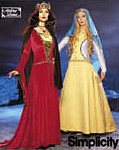
Sideless
Surcote & Cotehardie
Simplicity 9785
Do not use the red dress, it's fantasy. Avoid it at all
costs. The yellow sideless surcote is a fair sort of pattern.
Uses approx 6 metres of fabric, and the same for lining.
You can make your own with less fabric. I haven't heard
if the underdress pattern is a good one. Anyone out there
used it? Please let
me know.
|
|
|
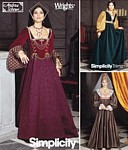
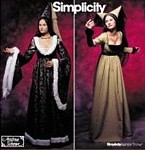
Lady's
15th century Burgundian gown
Simplicity 9929
The bottom right picture is good with some modifications.
The collar needs to be fabric or fur, not lace. Fake fur
usually looks dreadful, so a black cotton velveteen works
well. The sleeve needs to to a straight sleeve. Usually
this dress opens at the front and is laced on the inside
and covered with a really, really wide belt. The V piece
you see is your underdress showing, not a sewn in bit. The
big picture on the left is too late for a medieval event.
It's Renaissance. Avoid the top right pic.
|
|
|
15th
Century Yorkist Gown/ Burgundian Gown
Simplicity 9058.
A pair of 15th century gowns and hennins. Between the two
patterns, you get one good dress. Start with the dress on
the left, but use the sleeves from the dress on the right.
The sleeves should be permanently sewn in and leave off
the frills at the wrist. Do not use the big sleeves!!
Again, the collar looks bad in fake fur, so use a black
velveteen instead. The pointy hat (hennin) is right. Usually
this dress opens at the front and is laced on the inside
and covered with a really, really wide belt. The V piece
you see is your underdress showing, not a sewn in bit.
|
|
|
Mens
or Womans Basic Tunic
Style 2313
This pattern can be found in Op shops here and there and
can be used for both men and women. Widen the shoulders
a little for men. Man can have a split up the front or sides.
Try to keep the sleeves straight. For women, use this as
either an underdress or to use as an overdress, you can
widen the sleeves or keep them straight and make the bottom
hem flare out to add fullness. Pull it in at the waist with
a belt.
|
Patterns
for hoods & cloaks
Headwear played
an important part of dressing in the middle ages. Hoods can be
both plain or decorative with daggues (the bits that hand down
around the bottom) and long liripipes (the long dangly bit on
the hood at the back). Hoods can be made particolour- one colour
on the left, another colour on the right. Cloaks tended to be
plain and were functional.
No crushed velvet or shiny satins please.
|
|
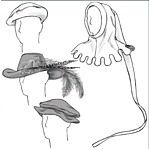
Mens
headwear
McCalls M4805
I believe this pattern is a bit expensive, but the hood
on the top right hand side is GREAT!! This is exactly what
would have been worn. You can make this pattern without
the daggues and just have a straight bottom instead of the
curvy one if you like.
|
|
|
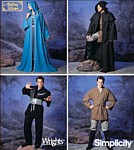
Men
or women's cloak
Simplicity 5840
ONLY the top two patterns are any good medieval wear. The
bottom two are not suitable.
|
For better information on
how to make medieval clothes, try Sarah Thursfield's excellent
Medieval Tailor's Assistant and remember, it's usually
the good choice of colour and fabric which really makes a dress
shine rather than a complicated pattern.

Copyright
© Rosalie Gilbert
All text & photographs within this site are the property of
Rosalie Gilbert unless stated.
Art & artifact images remain the property of the owner.
Images and text may not be copied and used without permission.
|