Medieval
Purses, Pouches, Aumonieres & Bags
PURSE STYLES - FABRICS - DECORATION
 Pockets
were unknown in medieval clothing, therefore purses and pouches
of various kinds were widely utilised by all people of all classes.
Purses were small cloth purses also known as aumonieres or alms
purses. Pockets
were unknown in medieval clothing, therefore purses and pouches
of various kinds were widely utilised by all people of all classes.
Purses were small cloth purses also known as aumonieres or alms
purses.
Paris was well known during the 14th century for producing some
of the finest of these. It was not uncommon for the embroidery
to depict scenes of courtly love. Many were given as gifts and
it was deemed an appropriate embroidery activity for aristocratic
ladies.
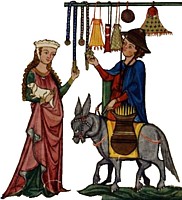
The detail at right comes from the 14th century Manesse Codex
and shows a woman looking at different styles of belts and bags
which are being offered for sale by a merchant.
 Styles
of bag Styles
of bag
Styles of bags differed for women and men. Women often preferred
the drawstring kind, while men opted for the more practical leather,
kidney-shaped bag.
Bags could be square, rectangular or trapezoid.
Ladies styles of fabric bag
varied a little but generally were either square or rectangular
with two drawstrings across the top, running horizontally one
in each direction, with or without tassels, some having a rounded
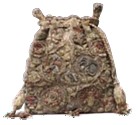
top. The example at left above is dated between 1400-1600 from
the British Isles. Image from the Metropolitan Museum of Art.
It shows the typical drawstrings with tassels closure at the top.
 It
attaches to the belt by the means of two loops at the very top.
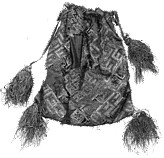
Shown at right is a similar style of fabric bag with drawstring
and tassels dated between 1276 and 1300. It
attaches to the belt by the means of two loops at the very top.
Shown at right is a similar style of fabric bag with drawstring
and tassels dated between 1276 and 1300.
 Both
men and women utilised the small, drawstring pouch or aumoniere
pouch for the keeping of alms. These might be attached to the
belt by the use of a belt hook, a purpose made attachment on the
belt. Both
men and women utilised the small, drawstring pouch or aumoniere
pouch for the keeping of alms. These might be attached to the
belt by the use of a belt hook, a purpose made attachment on the
belt.
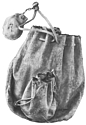
They might be made of plain fabric, embroidery or soft leather.
Shown at the left is a leather drawstring pouch with two mini-pouches
attached. It is dated to approximately the 1400s and is part of
the collection in the Stadt Museum in Germany. It is a basic u-shape
design which is stitched up the sides.
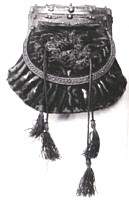 Another
style of 15th century purse, featuring an iron metal framework
is pictured at the left. It is from western Europe and made from
silk velvet. It is certain that because of the expensive metalwork
and fabric, that it did not belong to a commoner. Another
style of 15th century purse, featuring an iron metal framework
is pictured at the left. It is from western Europe and made from
silk velvet. It is certain that because of the expensive metalwork
and fabric, that it did not belong to a commoner.
Fabrics
Some bags and pouches were made of soft leather, some of embroidered
silk on linen, some of velvet, and many with gold thread, embroidery
and tapestry.
When Queen Jeanna of Burgundy was crowned in 1317, she received
twelve embroidered purses, six velvet purses, a further six embroidered
samite purses as well as sixteen other purses of an unknown type.
It is not unlikely that she gave most away as gifts.
In 1319, a countess is recorded as giving a gift of a purse which
was embroidered with pearls, which shows that many purses as well
as being utilitarian were very costly and ornate.
Decoration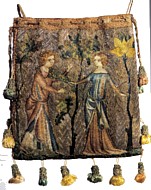
Medieval bags were often heavily embroidered front and back with
scenes of courtly love. The image at left shows Game With A
Hood on a 1340 aumoniere from Paris. Along with it's embroidery,
and coloured drawstrings, it has many decorative tassels along
the bottom and a band added at the upper opening where the double
drawstring is. The embroidery shows a fashionably dressed young
couple in a garden. It is embroidered with couched gold and silver
threads and split stitched for the remainder on linen.
Margherita Datini's, the
wife of a wealthy Italian businessman's 1397 personal effects
list includes two purses described as embroidered wool.
 It
is not specified whether the purses were made of wool and embroidered
with perhaps silks and gold threads or whether they were made
of woolen cloth and embroidered also with wool. It
is not specified whether the purses were made of wool and embroidered
with perhaps silks and gold threads or whether they were made
of woolen cloth and embroidered also with wool.
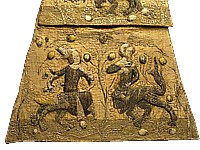
The sample at right appears
to be gold couched embroidery and split stitch on gold silk. The
man and the woman are human above the waist indicating their courtly
and proper halves whist below the waist they are depicted as animals
symbolising their bestial passions which come from their nether
regions below. It is dated at the mid 14th century and is of French
origin.

Copyright
© Rosalie Gilbert
All text & photographs within this site are the property of
Rosalie Gilbert unless stated.
Art & artifact images remain the property of the owner.
Images and text may not be copied and used without permission.
|