The Medieval Tailor's Workshop
Sewing samples from the 14th & 15th centuries

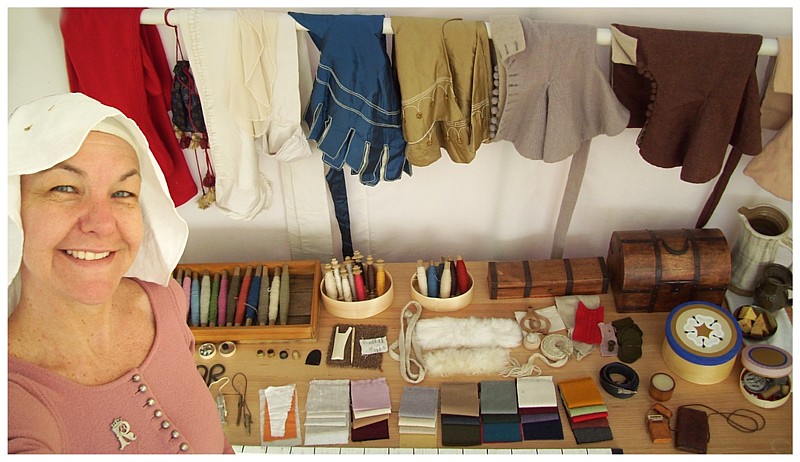
My Interactive Tailor's Workshop is often set up at events for members of the public to come and be educated about what tools people who sewed clothing might have used.

The entire thing is touchable! People may feel the weight of hand-forged scissors, touch samples of real ermine, look at linen sewing threads, traditionally dyed wools and discover that not ALL wool is scratchy or hot. There are samples of tailoring, items like buttons, needles and pins and samples of common medieval clothing.

Often through the day, free lucet classes or cloth button making workshops are held so sewers can learn textile skills for themselves to take home.

And of course, sewing help is available for people making their own outfits.


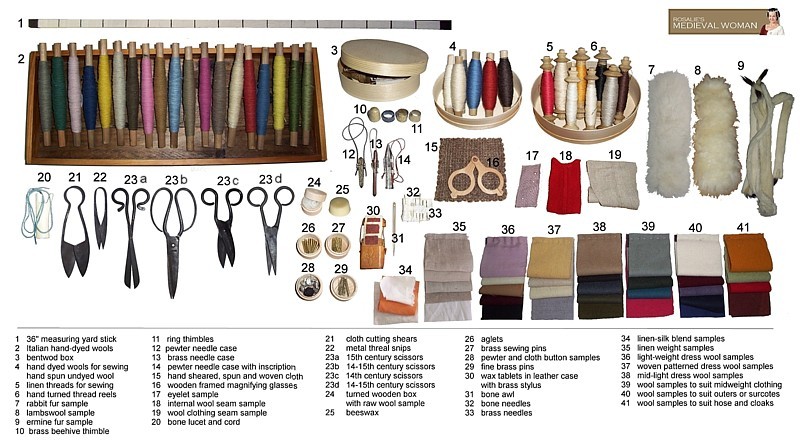
1. Measuring stick.

Country of Origin: Italy
Time Period: Medieval
Type of Item: Measuring stick
Outer Colour: White
Construction Materials: Hardwood
Details of Construction: 36 inch wooden measuring stick Hand made
Details of Decoration: painted with markings at one inch.
Made by: Rosalie's Medieval Woman, Brisbane.
Documentation A Tailor's Workshop, Tacuinum sanitatis, MS 1673, Bibliotheque Nationale, Paris.
Seen in the image from the 14th century, A Tailor's Workshop, Tacuinum sanitatis, MS 1673, Bibliotheque Nationale, Paris.
2. Italian hand-dyed wools.

Country of Origin: Italy
Time Period: Medieval
Type of Item: Wool thread
Details of Construction: Italian spun wool
Details of Decoration: Hand dyed using period methods
Made by: Silvio's Workshop, ItalyWools which have been locally sourced in the Italian countryside, hand spun and dyed naturally using medieval techniques and dyestuffs.
Colour range includes the first, second and third dye baths.

Produced by Silvio Luciani, Italy.
- yellow - weld
- pinks - cocheneal
- browns - oak gall
- greys - ivy leaves
- blue -woad
- red - madder

3. Bentwood box.

Bentwood boxes can be seen in a variety of manuscripts as storage for small household items. These are made from Finnish poplar wood and are used for storage, transport and display of sewing threads.

Bentwood boxes of this type can be seen in several images in the Tacuinum sanitatis, 14th century.

4. Hand-dyed wools for sewing.

Hand-dyed woolen threads fine enough for sewing garments.

Made by:
- Wool, woad dyed (Historical Textiles, Sweden)
- Wool, madder dyed (Historical Textiles, Sweden)
- Wool, undyed (Historical Textiles, Sweden)
- Wool, oak gall dyed (Historical Textiles, Sweden)
- Wool, undyed, hand spun (15th Century Spinning, Australia)
5. Linen threads for sewing.

Country of Origin: Stockholm, Sweden
Time Period: Medieval
Type of Item: Linen thread
Details of thread : from left to right:
- Unbleached linen, hand spun (Historical Textiles, Sweden)
- Off white linen, commercially produced (Gutermann, Spotlight)
- White linen, commercially produced (Gutermann, Spotlight)Linen thread was used for sewing garments.
These samples are both dyed and undyed.

Black, brown, red, yellow and white commercially produced through Guterman.

Natural and white, hand-spun (Historical Textiles, Sweden)(15th Century Spinning, Australia)
6. Hand-turned thread reels.

Country of Origin: England
Time Period: Medieval
Type of Item: Thread reel
Outer Colour: Natural
Construction Materials: Hardwood
Details of Construction: Hand turned
Details of Decoration: unvarnished

Bought from: Medieval Design, Italy
Documentation: Based on Artifact fragment, Mary Rose 15th century based on a fragment cited in the Museum of London book "Medieval Finds from Excavations in London- The Medieval Household"- SWA81 Acc No 1342, page. 270.The design of these reels is based on an artifact find housed in the Museum of London.

Artifact fragment, Mary Rose 15th century based on a fragment cited in the Museum of London book "Medieval Finds from Excavations in London- The Medieval Household"- SWA81 Acc No 1342, page. 270.

6b. Hand-turned thread reels.

Country of Origin: England
Time Period: Medieval
Type of Item: Thread reel
Outer Colour: Natural
Construction Materials: Hardwood
Details of Construction: Hand turned
Details of Decoration: None
Made by:
Bought from: Historic Enterprises, USA
Documentation: Artifact fragment, Mary Rose 15th century based on a fragment cited in the Museum of London book "Medieval Finds from Excavations in London- The Medieval Household"- SWA81 Acc No 1342, page. 270.

Country of Origin: England
Time Period: Medieval
Type of Item: Thread reel
Outer Colour: Natural
Construction Materials: Hardwood
Details of Construction: Hand turned
Details of Decoration: None
Made by:
Bought from: Walter
Documentation: Artifact fragment, Mary Rose 15th century based on a fragment cited in the Museum of London book "Medieval Finds from Excavations in London- The Medieval Household"- SWA81 Acc No 1342, page. 270.

7. Rabbit fur sample.

Country of Origin: England
Time Period: Medieval
Type of Item:
Outer Colour/colours:
Construction Materials:
Details of Decoration/finishes:
Made by: Rosalie
Bought from:This sample has been recycled from vintage clothing.
Documentation:

Notes: Rabbit (or coney) fur was offten used my lower and middle classes for lining outer garments and hoods.

Many people are often surprised to see how soft and luxurious white rabbit fur is, as there is a popular modern belief that anything lined in rabbit fur must be not luxurious.

8. Lambswool/Budge sample.

Country of Origin: England
Time Period: Medieval
Type of Item:
Outer Colour/colours:
Construction Materials:
Details of Decoration/finishes:
Made by: Rosalie
Documentation:Wool was sometimes used for linings for the working classes.

This sample has been taken from a second-hand source.
9. Ermine fur sample.

Country of Origin: England
Time Period: Medieval
Type of Item:
Outer Colour/colours:
Construction Materials:
Details of Decoration/finishes:
Made by: Rosalie
Documentation:Ermine was one of the favourite choices for the upper classes for lining and dress trimmings.


This sample has been acquired from vintage estate, and has not supported the fur industry. Its purpose is to provide a historically accurate teaching tool.
10. Beehive thimble.

Country of Origin: England
Time Period: 1350-1400
Type of Item: Domed thimble
Outer Colour/colours: Gold
Construction Materials: Brass
Details of Construction: Cast of hand punched artifact
Details of Decoration & Finishes: none
Imported from: Medieval Design, Italy
Documentation: Artifact the Gilbert Collection
Notes: Thimbles could be made from brass or copper alloy. The dimples were usually hand punched in the 14th century with machine drilled holes becoming more prevelant in the 15th century. Thickness was determined by the intended use. This reproduction has been hand cast traditionally and matches for thickness and weight, a similar one in The Gilbert Collection.

11. Ring thimbles.

Country of Origin: England
Time Period: 1350-1400
Type of Item: Ring thimble
Outer Colour/colours: Gold
Construction Materials: Brass
Details of Construction: Cast of hand punched artifact
Details of Decoration & Finishes: none
Imported from: Medieval Design, Italy
Notes: These were also used through the medieval period.
Dimples were usually round but in the 15th century, it was not uncommon for the dimples to be triangular or rectangular shaped.
The first one is pressed metal and lighter weight. The second is cast and sturdy.

Country of Origin: England
Time Period: 14th century
Type of Item: Ring thimble
Outer Colour/colours:
Construction Materials: Brass
Details of Construction: Handmade of sheet brass
Made by: unknown
Bought from: Mainly Medieval
Documentation examples in the Museum of London's "Dress Accessories- Medieval Finds from Excavations in London
Ring Thimble

Country of Origin: England
Time Period: 14th century
Type of Item: Ring thimble
Outer Colour/colours: black
Construction Materials: Iron?
Details of Construction: Cast in one piece
Details of Decoration & Finishes: Original would have had hand punched holes
Made by:
Bought from: Abbey Museum of Art & Archaeology gift shop
Documentation: 14-15th Century Ring thimble 19mm gaukler originals

Leather thimble

Country of Origin:
Time Period:
Type of Item: Leather thimble
Outer Colour/colours: Black
Construction Materials: Suede, linen thread
Details of Construction: Hand stitched
Made by: Rosalie
Documentation

12. Pewter needle case.

Country of Origin:
Time Period: 14th-15th century
Type of Item: Needlecase
Outer Colour/colours: silver
Construction Materials: Pewter
Details of Construction: Total length of needle case is 5.3cm.
Details of Decoration & Finishes: Lozenge shaped finish.
Made by: Made in the Czech Republic.
Bought from: Gift fromLissa- bought from Make Your Own Medieval
Documentation Artifact Based a design from a 14th century artifact from the Thames, held at the V&A.

13. Brass needle case.

Country of Origin: England
Time Period: 14th-15th century
Type of Item: Needlecase
Outer Colour/colours: brown
Construction Materials: Brass
Details of Construction: Hand made
Details of Decoration & Finishes: none
Made by: Robin Mackay
, Gesithus, Brisbane.
Documentation Artifact MoL Based on an artifact from the Museum of London as seen in the Museum of London Excavation book.

14a. Pewter needle case with inscription.

Country of Origin: Netherlands
Time Period: 14th-15th century
Type of Item: Needlecase
Outer Colour/colours: Silver
Construction Materials: Lead free pewter
Details of Construction: Cast. 1.2cm internal diameter x 9.5cm length
Details of Decoration & Finishes: floral design in each panel with acorn finials at either end. It has the names of the Three Kings of Cologne and an invocation to the Blessed Virgin on the lower part. The upper and lower parts are strung together on cords
Made by: Lionheart Replicas, UK,
Bought from: Mainly Medieval
Documentation Artifact Netherlands
Notes: Slightly adapted from a 15th c. needle case from the Netherlands (Schatten) and similar to an English example (MoL, Pilgrim Souvenirs, fig. 7).

14b. Tower-shaped pewter needle case.
Country of Origin: Netherlands
Time Period: 15th century
Type of Item: Needlecase
Outer Colour/colours: Silver
Construction Materials: Lead free pewter
Details of Construction: Cast. 97 x 26mm
Details of Decoration & Finishes: Slightly adapted from a 15th c. needle case from the Netherlands (Schatten) and similar to an English example (MoL, Pilgrim Souvenirs, fig. 7). It has the names of the Three Kings of Cologne and an invocation to the Blessed Virgin on the lower part. The upper and lower parts are strung together on cords
Made by: Billy and Charlie,USA.
Documentation Artifact, Schatten uit de Schelde, p.43; Pilgrim Souvenirs, fig. 7

14c. Leather Needle case.

Country of Origin: Koln, Germany
Time Period: 14th century
Type of Item: Needlecase
Outer Colour/colours: black
Construction Materials: leather
Details of Construction: hand made, naturally dyed
Details of Decoration & Finishes:
Made by: Frank Becker, Germany
Documentation Extant Artifact,

15. Hand-sheared, spun and woven cloth sample.

Sample made by my sister when she was a teenager with very little experience. The fleece was home washed, spun and woven into cloth. This sample shows what can be achieved by a young person without years of experience.

16. Wooden framed magnifying glasses.

Hand-sheared, spun and woven cloth sample

Sample made by my sister when she was a teenager with very little experience. The fleece was home washed, spun and woven into cloth. This sample shows what can be achieved by a young person without years of experience.

Wooden framed magnifying glasses

By the 14th century, eyeglasses start to appear in manuscripts for tradesmen although they appear in written records and a few artworks from the early 14th century onwards. Oak frames made by Malcolm Fraser, Sweetness & Light, England.

By the 14th century, eyeglasses start to appear in manuscripts for tradesmen although they appear in written records and a few artworks from the early 14th century onwards. Oak frames made by Malcolm Fraser, Sweetness & Light, England.

17. Eyelet sample.

Country of Origin: England
Time Period: Medieval
Type of Item:
Outer Colour/colours:
Construction Materials:
Details of Decoration/finishes:
Made by: Rosalie
Documentation:Sample of hand-sewn eyelet for dress lacing.

18. Internal woolen fabric seam sample.

Country of Origin: England
Time Period: Medieval
Type of Item:
Outer Colour/colours:
Construction Materials:
Details of Decoration/finishes:
Made by: Rosalie
Documentation:Sample of stitched down seam for woolen garment.

Wool sleeve sample showing buttonholes.

Country of Origin: England
Time Period: Medieval
Type of Item:
Sample of hand stitched 14th century wool kirtle sleeve with linen re-inforcing strip and buttonholes hand stitched at 2cm intervals.
Outer Colour/colours:
Construction Materials:
Details of Decoration/finishes:
Made by: Rosalie
Documentation:

Based on Museum of London finds.

20. Bone lucet and cord.

Country of Origin:
Time Period: Medieval
Type of Item: Lucet
Outer Colour: Natural
Construction Materials: Bone
Details of Construction: Hand shaped and sanded
Details of Decoration & Finishes: No decoration
Made by: Rosalie made by Rosalie Gilbert.
Documentation Artifact sheep bone lucet, York. 13th C Sigtuna Museum, Sweden Lucet based on multiple finds from Sweden housed at the Sigtuna Museum.

21. Cloth cutting shears.

Country of Origin: Europe & England
Time Period: 14th century
Type of Item: Scissors
Outer Colour/colours: black
Construction Materials: Iron
Details of Construction: cm. Handforged.
Details of Decoration & Finishes: none
Imported by: Medieval Design, Italy
Documentation Copy of 14th century artifact from the Thames, England.
Housed at the V&A Museum.

22. Metal thread snips.

Country of Origin: England
Time Period: 14th century
Type of Item: Scissors
Outer Colour/colours: black
Construction Materials: Iron
Details of Construction: cm. Commercially produced
Details of Decoration & Finishes: none
Made by: Bought Make Your Own Medieval
Documentation: Based on an extant artifact in the Abbey Museum of Art & Archaeology, Caboolture.

23a. 15th century scissors.

Country of Origin: Russia
Time Period: 15th century
Type of Item: Scissors
Outer Colour/colours: black
Construction Materials: Iron
Details of Construction: 22cm. Handforged.
Details of Decoration & Finishes: none
Made by: ?
Imported by: Make Your Own Medieval.
Documentation Artifact Novgorod Musuem, Russia. Source 13th/15th C medieval paintings.

23c. 14th century scissors.

Country of Origin:
Time Period: 14th century
Type of Item: Scissors
Outer Colour/colours: black
Construction Materials: Iron
Details of Construction: cm. Handforged.
Details of Decoration & Finishes: none
Imported by: Lacis, California
Documentation: Based on the image from the 14th century, A Tailor's Workshop, Tacuinum sanitatis,
MS 1673, Bibliotheque Nationale, Paris

23d. 14-15th century scissors.

Country of Origin:
Time Period: 14th century
Type of Item: Scissors
Outer Colour/colours: black
Construction Materials: Iron
Details of Construction: cm. Handforged.
Details of Decoration & Finishes: none
Imported by: Medieval Design, Italy
Documentation: A copy of unnamed artifact.
Also seen 15th century painting detail, The Holy Family.

24. Turned wooden box with raw fleece samples.

Raw Wool Sample
Country of Origin: England
Time Period: Medieval
Type of Item:
Outer Colour/colours:
Construction Materials:
Details of Decoration/finishes:
Made by: Rosalie
Documentation: Sample of fleece straight from the sheep!

25. Beeswax.

I use beeswax prior to threading the needle for sewing to stop the thread from fraying.

26. Aglets.

Country of Origin: England
Time Period: Medieval
Type of Item: Sign
Outer Colour/colours: Painted
Construction Materials: Pine board, acrylic paint, metal hooks
Details of Decoration/finishes: Painted
Made by: Rosalie
Documentation: Copies from Artifacts
Notes: Metal aglets were used at the end of dress or hose laces, much like the plastic end of shoe laces today.

27. Brass sewing needle and pins.

Country of Origin: London, England
Time Period: 14th century
Type of Item: ball headed pins
Colour: Brass
Construction Materials: Brass
Details of Construction: Hand made
Made by: Bero, Germany
DocumentationThicker sewing pins for use on wools. Finds of pins from the medieval period are extremely common.

Hand made by Bero von Saeckingen
Bero Heftelmacher, Germany.

28. Pewter and cloth button samples.

Reproduction pewter buttons which are hand cast. Hand stitched fabric buttons.

- Cloth button - wool, hand made (Rosalie)
- Pewter button, red centre (Lionheart Replicas, England)
- Pewter button, nipple type (Gesithas, Australia)
- Pewter button, large, glass stone (Steve Millingham Pewter Replicas, England
- Pewter button, decorated
- Pewter button, conical (Gesithas, Australia)

29. Fine brass pins.

Country of Origin: London, England
Time Period: 14th century
Type of Item: Pins
Colour/colours: Brass
Construction Materials: Brass
Details of Construction: Manufactured.
Made by: Birch
Bought from: Spotlight
Documentation artifact finds
Notes: Used for sewing fine cloths for veils etc. Fine linens and silks.

31. Bone awl.

Country of Origin: England
Time Period: 14th century
Type of Item: Awl
Colour/colours: White
Construction Materials: Bone
Details of Construction: Hand fashioned with hole drilled.
Details of Decoration & Finishes: No decoration
Made by: Hornmaster
DocumentationHand made bone awl for making eyelets.
Made by Jean the Hornmaster, Australia.

32. Bone needles.

Country of Origin: England
Time Period: 14th century
Type of Item: Needles
Colour/colours: White
Construction Materials: Bone
Details of Construction: Hand fashioned with hole drilled.
Details of Decoration & Finishes: No decoration
Made by: Stag InnHand made bone needles which are good for sewing wool.
Hand made by Stag Inn, Australia.

33. Brass needles.

Country of Origin: London, England
Time Period: 14th century
Type of Item: Needle
Colour: Brass
Construction Materials: Brass
Details of Construction: Hand made with drilled thread hole
Bought from: Medieval Design, Italy
Made by: unknown
DocumentationHand made brass needles which are good for all sewing.

Country of Origin: London, England
Time Period: 14th century
Type of Item: Needle
Colour: Brass
Construction Materials: Brass
Details of Construction: Hand made with drilled thread hole
Made by: Malcolm Fraser, Sweetness & Light, UK.

Leather Bound hand made sample & pattern book

Country of Origin:
Time Period: 1300 onwards?
Type of Item: Journal
Outer Colour: Mid Brown
Construction Materials: Leather, hand-made paper
Details of Construction: Hand made
Details of Decoration & Finishes:
Made by: Pawel, Etsy shop, Poland

34. Linen-silk blend samples.

Country of Origin: England
Time Period: Medieval
Type of Item: Wool cloth
Colour: Many colours
Details of Construction: Wool swatches, cut and blanket stitched into swatch books
Made by: Rosalie from offcuts

A selection of linen silk blends suitable for undergarments or light outer garments.

35. Linen weight samples.

A selection of linens suitable for veils, aprons and underclothes.

Country of Origin: England
Time Period: Medieval
Type of Item: Wool cloth
Colour: Many colours
Details of Construction: Linen swatches, cut and blanket stitched into swatch books
Made by: Rosalie from offcuts

A selection of linens suitable for veils, aprons and underclothes.

36. Light-weight dress wool samples.
Wools suitable to be used for summer clothing.


37. Woven patterned dress wool samples.
Wools woven in stripes or herringbone.


38. Mid-light weight dress wool samples.


39. Wool samples to suit mid-weight clothing.


40. Wool samples to suit outers or surcotes. Thickish wools for cold weather for clothing.


41. Wool samples to suit hose or cloaks.
Thick wools suitable for cold weather clothing or bedding.

Hand spun and dyed wool fabric

Country of Origin:
Time Period:
Type of Item: Woollen cloth
Outer Colour/colours: orange
Construction Materials: wool
Details of Construction: hand made, naturally dyed
Details of Decoration & Finishes:
Made by: Marija Neijman
Bought from:
Documentation:


42. Tailor's chalk
Tablet weaving samples

43. Niddy noddy

Niddy noddy based on the manuscript

Country of Origin: Europe
Time Period: Medieval
Type of Item: Niddy noddy - wood winder
Outer Colour: natural
Construction Materials: Pine
Details of Construction: Hand made
Made by: Rosalie
Documentation The three daughter of ... 14th century manuscript

Made by Rosalie's Medieval Woman, Brisbane.

Round Bentwood Box with lid - pink

Country of Origin: Italy
Time Period: 1360-1390
Type of Item: Bentwood box
Outer Colour/colours: pink
Inner colour/ colours: Light brown
Construction Materials: Birch
Details of Construction: Commercially produced.
Details of Decoration & Finshes: Undecorated
Made by: Painted by Rosalie
Bought from: Op Shop
Documentation: Manuscript,

Bentwood box with birds

Country of Origin: Generic
Time Period: Medieval
Type of Item: box
Outer Colour/colours: painted
Construction Materials: thin plywood box
Details of Decoration/finishes: Han dpainted by Rosalie
Bought from: Cheese box from Woolies
Documentation: Copies from Artifacts, Artwork from manuscript bestiary.

Turned wooden boxes
Country of Origin: Generic
Time Period: Medieval
Type of Item:
Outer Colour/colours:
Construction Materials: Unfinished pine
Details of Decoration/finishes: Height: 1 inch / 2,7 cm, Diameter: 1,5 inch / 3,9 cm
Bought from; Coloricrafts, Poland
Documentation: Copies from Artifacts
Bentwood storage and display boxes Set of three

Country of Origin: Generic
Time Period: Medieval
Type of Item:
Outer Colour/colours: Natural
Construction Materials: Finnish poplar
Construction method: steamed and then bent under pressure
Details of Decoration/finishes: none
Sizes: 8-1/2" x 4-1/2" x 3"
8-1/4" x 4-1/8" x 2-3/4"
7-3/4" x 3-3/4" x 2-1/2".
Bought from: Holzalbum, Germany
Documentation: Copies from manuscript Tacuinum sanitatus


Copyright © Rosalie Gilbert
All text & photographs within this site are the property of Rosalie Gilbert unless stated.

Art & artifact images remain the property of the owner.
Images and text may not be copied and used without permission.