|

fabrics
& sewing
basic
medieval
clothing
sewing
tutorials
eyelet
tutorial
buttonhole
tutorial
cloth
button
tutorial
lucet
cord
tutorial
tassel
tutorial

|

Sewing
Tutorial:
Basic Surcote With Only Four Seams
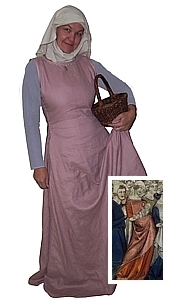
Re-enactors can use this
pattern for a working class surcote which isn't too big or too
formal. Non-reenactors, you can made it out of silk or brocade
and with a train and it's gorgeous for feasts!
This is an overdress and always has something with long, fitted
sleeves underneath. Make it from linen for day wear with higher
sleeve holes or cut away a little. Make it for feasts and formal
events- it can be cut away quite a bit to show off your fancy
undergown.
 |
Step
1
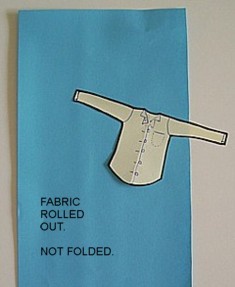
You need: your fabric, pins, scissors and a cotton shirt for
sizing.
Don't use a stretchy one as it can give a false sense of how
it will fit you around the bust because it will have a lot
of give. Your surcote won't have that, and it will be too
small.
If you don't have a cotton shirt, get thee to an Op Shop and
spend $3 and get one that you don't mind cutting up. Make
sure it's not too tight.
Lie your fabric flat on the floor unfolded. |
 |
Step
2
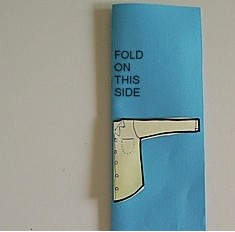
Fold your shirt and your fabric in half lengthways. The good
side of the fabric is on the inside.
It doesn't matter if your arm goes off the edge. There are
no sleeves on this surcote, so it doesn't matter.
If your fabric is skinny, you will need to fold your fabric
double (two runs of fabric instead of a folded over piece)
before you begin. Your folded shirt matches the side with
the folded fabric.
Fabric fold check! Your fold is on the left side. Your loose
sides are on right. Your shirt is sitting right in that corner
ready to mark out your surcote. |
 |
Step 3
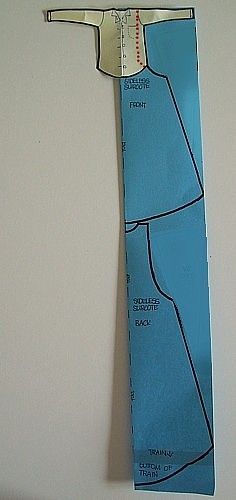
Marking out your pattern. This is not quite so terrifying
as it sounds.
Always, ALWAYS cut the seams a bit bigger than you think
you need. You can always take a dress in but it's really
hard to add pieces in once it's cut. The bottom one will
be longer at the bottom so you have a train.
If you are doing a
high sleeveholes, mark higher where the sleeves are.
If you are making a
sideless one, mark your seam from the edge of your shoulder
straight down to your belly button and then curve out to
your hip where the dotted red lines are and then out to
the fabric edge for the skirt. The front width should be
as wide as your nipples or a bit wider. The back is wider.
You will need to mark out 2 of them. One for the front and
one for the back. You can cheat by cutting out one and simply
tracing around it to make the other one. The back one is
wider across your back, remember.
To get the size of your skirt, draw a line from the hip
(the bottom of the shirt) to the very edge of the fabric.
The wider your fabric, the more skirt you'll have. Your
centre seam is as long as you are to the ground. If you
want a train, allow more. okay, start pinning!
|
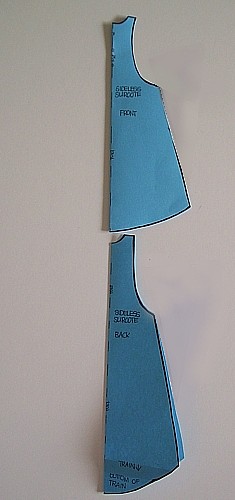 |
Step 4
Just double check again that the fabric is folded the right
way before you cut anything...
It should look like
this...
Cut your new surcote out.
Unpin the sides now that your dress is cut.
It looks like this.
|
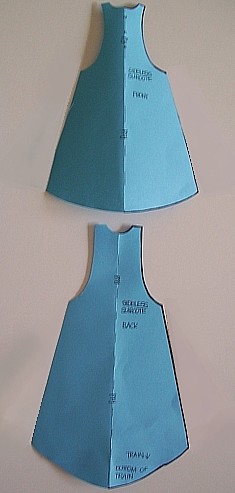 |
Step
5
Unfold the surcote so you can clearly see your two pieces.
It looks like this.
One piece is thinner at the front across the chest and shorter
at the hem.
One piece is wider at the back and longer at the bottom. This
is your back. |
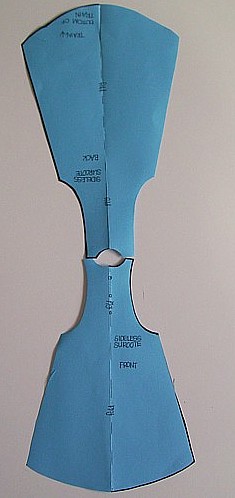 |
Step
6
Unfold your dress altogether.
Swing one piece around 180 degrees so the shoulder pieces
are touching.
Make sure your fabric is the right way out so you have the
two good sides together. When it's spread out of the floor,
it looks like this.
The side you want to be the front is the one without the train.
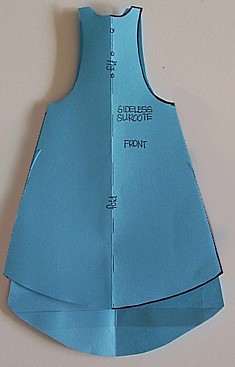
Cut the neckline at the front a little lower. Just a little.
Remember, you can take more off, but it's really hard to put
it back on. Okay so now you have a front.
You will want to double check the front of your surcote is
not as wide as the back. Don't forget to allowing for double
folds for hemming. |
 |
Step 7
Pin the shoulders together, remember to double check the
good side of the fabric is facing the good side of the fabric.
You want your sewing on the wrong side, so the good sides
face inwards.
Pin, pin, pin those side seams all the way from the hem
to the hip. Now try it on.
Once you're happy with the fit and you've adjusted your
neckline, sew your two side seams and you're finished!
Now is the time to trim the front of the surcote a little
if you want a really cutaway garment. Remember, you need
to allow enough fabric to do a rolled hem around the side
openings.
If you want to fur trim, you can, but normally the fur trimmed
surcotes have gores and extra fabric, and there's another
tutorial which is almost as easy as this one for that!
Happy sewing!
|
 You
can also line this surcote with a contrasting colour. All
you need to do is cut two of these together and sew them together.
If you are doing this, just be aware that sewing the armholes
can be a bit perilous. Do them one at a time. Do the neck seperately.
Do the hem last of all. ALWAYS pin and try on before you sew.
It beats the heck out of unpicking later on. If you just sew it
all at once, you may accidentally sew the surcote to itself and
it won't turn back right-way out. I've done this. It took forever
to unpick. You
can also line this surcote with a contrasting colour. All
you need to do is cut two of these together and sew them together.
If you are doing this, just be aware that sewing the armholes
can be a bit perilous. Do them one at a time. Do the neck seperately.
Do the hem last of all. ALWAYS pin and try on before you sew.
It beats the heck out of unpicking later on. If you just sew it
all at once, you may accidentally sew the surcote to itself and
it won't turn back right-way out. I've done this. It took forever
to unpick.
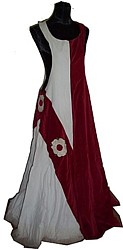
Other variations include making a particolour surcote-
that is one colour on one side and another colour on the other
side, but be careful cutting out that your sides line up. One
entire side should be all the way from centre seam to back seam.
The photo here shows a particolour with heraldry on it. The is
another fabulous way to make a very easy pattern dress up and
look a bit more special.

Copyright
© Rosalie Gilbert
All text & photographs within this site are the property of
Rosalie Gilbert unless stated.
Art & artifact images remain the property of the owner.
Images and text may not be copied and used without permission.
|
