Medieval
Women's Underpants
EXISTING GARMENTS - SOURCES - UNDERPANTS IN HOUSEHOLD
ROLLS - THE TOPSY-TURVY WORLD
UNDERGARMENTS & HORSE-RIDING
 A
Question of Underpants, Trewes, Clouts or Braes A
Question of Underpants, Trewes, Clouts or Braes
It seems to be generally accepted as "one of those things
that everybody knows" is that medieval women did not wear
underpants.
I believe this is not so.
To women of child-bearing ages, this would certainly not be an
appealing thought, especially when considering certain times of
the month.
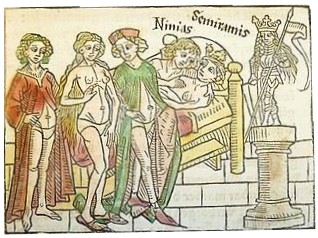
To date, I have only seen
a couple of clear images of a woman wearing underpants in art,
one shown at right and the other below. There are a couple of
written references to underpants for women, but not many. This
does not mean that they never wore them.
The image at right shows Semiramus who was a mythological queen
of Assyria, in a woodcut from Boccaccios Famous Women dated
1474, now in the Bavarian State Library. While it does show figures
from a legend and not actual, living people, I personally feel
that these underpants were not painted on for modesty.
Sources
for medieval women's underpants
Underpants for medieval women aren't recorded or written about
greatly, although Ian Mortimer's book, A Time Traveler's Guide
to the 14th Century mentions aristocratic women's clouts as
a form of linen braes for women to wear when nature forces her
to do so.
In household rolls and in warderobe records they are not listed
specifically, except in one instance which is within the ordinances
issued to tailors concerning the value of the clothing which could
be charged for a particular garment.
In the book Fashion in
the Age of the Black Prince, Stella Mary Newton asserts that
a French Tailor's ordinance in 1350, the Ordonnances des rois
de France, mentions the cost of a chemise as no more than
8 deniers and for the robbes-linges (which were presumably
linen underpants)
the price was to be
the usual one for masculine underants of the same style.
This certainly seems to indicate
that women may have worn underpants of a similar style to men.
Astrida Schaeffer is a historian
who has investigated medieval women's underpants. Her independent
research has uncovered two pieces of further evidence for underpants
being worn seperate to the use of them for the menstrual cycle.
I quote her here in full, as her observations are quite compelling.
She writes first about a
tale involving fiction characters, and then further on an actual
legal case where underpants are a crucial part of evidence in
the trail.
"In the Roman de
Renart, it is clear that female braies were understood as a
mark of modesty - which of course implies that they were worn
by women. Called to account for his assault on Dame Hersent,
Renart insists the act was consenual because "he did not
remove her braies" ("et puis qu'i n'i ot braies traites")
(Le Roman de Renart, Branch I, 1287, cited in Burns, note 23).
In other words, since Renart did not have to remove Dame Hersent's
braies, she must have done so, signaling her sexual availability
and therefore his innocence. The presence or absence of the
braies is central to the argument."
The trial in which underpants
worn by females is mentioned can be found in Ravishing Maidens:
Writing Rape in Medieval French Literature and Law by Katheryn
Gravdal. Astrida Schaeffer again shares what she has discovered
about this court case in the early 14th century.
"...the young apprentice
Perrette la Souplice, a very real person living in Paris in
1337, is on official record as wearing her braies, which proved
to be a crucial piece of evidence at an actual, not literary,
trial. Perrette de Lusarche and Perrette la Souplice, both aged
twelve, were assaulted by Jehanin Agnes and their case went
to trial. The trial transcript includes the following account:
"Là, en un selier, fist entrer, oultre son gré
et par force, ladicte Perrete la Souplice, et la jeta à
terre, et avala ses braies, et se mist sus lui..." (There
in a cellar he made her go, against her will and by force, the
said Perrette la Souplice, and he threw her to the ground, and
pulled down her braies, and got on top of her...)
This shows that in 1337,
when the case was taken to court, underpants were worn by these
girls. It is a rare glimpse into the private world of feminine
undergarments which we would not have otherwise heard of.
Existing
garments
Until 2008, no existing underpants. In July 2008 investigations
for re-construction were carried out at the Castle Lengberg in
Nikolsdorf, East Tyrol, Austria. A vaulted spandrel was discovered
in the south wing which was filled with backfill- possibly to
level the floor when a further level was added. The fill was stored
for subsequent sorting at a later date.
When examined, it was revealed that the fill consisted of layers
of dry material, among them organic material- twigs and straw,
but also worked wood, leather (mainly shoes) and textiles. Photo
below at right ©Institute of Archaeologies, University of
Innsbruck.
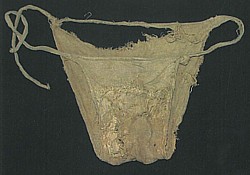 Among
the finds were a pair of linen underpants, shown at right, identical
to those shown being worn by men in illustrations in many artworks. Among
the finds were a pair of linen underpants, shown at right, identical
to those shown being worn by men in illustrations in many artworks.
Beatrix Nutz was part of the archaeological team who investigated
the textile fragments, and wrote of her findings supporting the
dating of the underpants to approximately 1480:
On the contrary –
a closer examination of the pieces in question showed that no
textile techniques were used in their construction that would
not fit to the time period. All applied techniques were common
during the 15th century and none of them developed later. Besides
- all other textiles from this find, like fragments of dresses,
shirts, trousers, laces etc., fit well to the 15th century.
The question of whether the
underpants found were worn by a man or a woman is not 100% conclusive
but due to the fragments of hose found with them, Beatrix Nutz,
the archaeologist who has studied them, believes that they were
worn by a man.
It is interesting to note that the underpants were found along
with items of breast support which we would call bras and corsolettes
today. Although probably worn by a man, they give a great insight
into what may have been available to the medieval woman at that
time.
Underpants
in household rolls
Perhaps there is no mention of women's underwear in household
accounts because most of the records and rolls were written by
male stewards who did not bother with such trifling and unimportant
items. Perhaps the items were of very little value and were not
recorded for this reason. Perhaps it was not an area any man wished
to enquire about.
It was then, as it was during the following centuries, private
and "unmentionable".
 It
is also possible that ladies' underpants do not rate a mention
because they were actually not worn at all and that in images
underwear was painted in for modesty's sake. It
is also possible that ladies' underpants do not rate a mention
because they were actually not worn at all and that in images
underwear was painted in for modesty's sake.
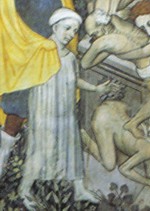
It does not seem that extra
modesty was required in the fresco The Fountain of Youth
painted from 1411 to 1416 by di Manta where the woman in question
was already covered by a fine chemise. A closer examination shows
a horizontal line and whitening where her underpants seem to be
although no corresponding whiteness at her breasts. In a time
period when sunbaking and tan lines were not known, it seems unlikely
that the white patch is merely her white bottom. Detail shown
at left.
Most other images show women bathing without pants or with their
privvy parts modestly covered by their hands or hair.
As a woman, I find this insistence
at the lack of underpants to be a little perplexing. What of the
menses? It is certain that women menstruated and it follows that
some method of dealing with the same was employed.
Many times I have been asked, usually in hushed tones and in a
private place, about underwear at this time of the month. Although
I have repeatedly read that women wore nothing, I believe that
in this day and age, if women feel the necessity to speak privately
on this matter, they would probably have been less inclined to
discuss it with any kind of record-keeper in the middle ages.
I feel some kind of underpants must have been worn, at least during
some times of the month.
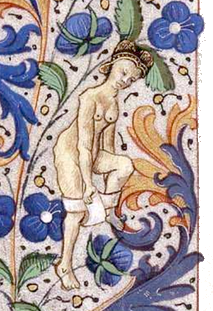 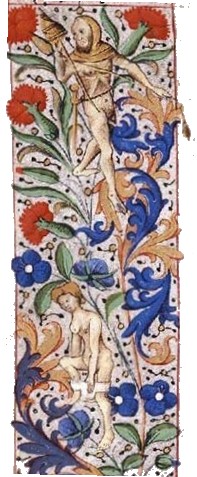 Interpreting
underpants in art Interpreting
underpants in art
Although there are only a few images of women wearing underpants
in medieval art, care must be taken in understanding these in
their full context.
A single image alone might show a women wearing underpants, but
other images on the same page show that the text indicated a world-gone-crazy,
topsy-turvy situation where the men are shown doing women's work
and the women are wearing the pants as a metaphor for running
the household.
Shown at right is a section of a marginal illumination which shows
exactly this. We see the wife putting on the pants, and the husband,
although still wearing his very masculine sword, using a distaff
which is usually a key icon of women's work.
Both of the images here are from the Biblioteca Nacional de Espana's
Horas de Alonso Fernández de Córdoba. It
is dated around 1465.
While these do show women
in underpants, context is the key.
Undergarments
and horse-riding
It is also known that many women rode horses although usually
on a saddle with a kind of foot platform which permitted genteel,
well-bred women to ride sidesaddle.
The Histoire de Guillaume le Mareschal, written circa 1226 tells
us:
While fleeing enemies,
Empress Matilda was riding cumme femme fait, en seant
as ‘women do, sidesaddle.’ Her Marshal told
her she would have to part her legs and ride astride because
they needed to get a move on. ‘Les jambes vos covient
desjoindre e metre par en son 'l’arcum.’
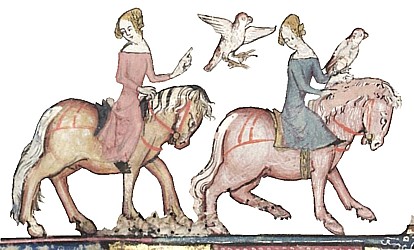
This shows us that although
a woman might choose to ride with her legs at the side, it was
not unknown for a woman to ride astride when required. Medieval
art, too, often confirms this with images like the detail from
the 14th century RomanceofAlexander, folio 80v which shows women
out hawking and riding astride.
 Some
other medieval women, like Margaret Paston, regularly rode in
her travels and according to Frances and Joseph Gies book, Women
of the Middle Ages, she probably rode astride as women
had always done rather than side saddle which was just coming
into vogue in the early 15th century. Some
other medieval women, like Margaret Paston, regularly rode in
her travels and according to Frances and Joseph Gies book, Women
of the Middle Ages, she probably rode astride as women
had always done rather than side saddle which was just coming
into vogue in the early 15th century.
As any horsewoman would be
well-aware, to ride astride vigorously with no underwear for protection
would be unlikely for all but the shortest periods. It is possible
that for short journeys where the rider does little more than
walk, protection other than the voluminous folds of gown were
sufficient for a woman's delicate nether regions. For extended
journeys, protection might have been warrented.
In Mistress, Maids and
Men by Margaret Labarge, we learn that the Countess of Leicester
seemed to have an undergarment made of fine leather. The skins
were delivered to her tailor, Hique, who also purchased 3 ells
of canvas for the same purpose. The Latin word used in the original
household roll is cruralia which suggests some kind of
shin coverings. It is known that the Countess rode astride often
and it is suggested by Margaret that these items were used to
make some kind of riding-breeches to protect her legs and underneath.

Copyright
© Rosalie Gilbert
All text & photographs within this site are the property of
Rosalie Gilbert unless stated.
Art & artifact images remain the property of the owner.
Images and text may not be copied and used without permission.
|