Weddings
and The Medieval Woman
CLOTHING - WEDDING JEWELLERY - BETROTHAL - LEGALITIES
OF MARRIAGE
WEDDING CUSTOMS - FEASTS - FLOWERS - WEDDING GIFTS
The word wedding comes
from the Old English wed, to pledge. Prior to 1100AD most marriages
did not include a religious ceremony. A public announcement, kiss
and consummation were all that was required.
Generally speaking, during the most of the medieval period, the
legal coming of ages for marriage was 12 for a girl and 14 for
a boy, although many peasant women did not marry but stayed with
their parents or worked for their older brothers in return for
food and shelter.
 Marriage
ceremonies and the celebrations that accompanied them largely
depended on the social class and wealth of the bride and groom.
The higher up the social ladder the bride, the more lavish were
the celebrations. Marriage
ceremonies and the celebrations that accompanied them largely
depended on the social class and wealth of the bride and groom.
The higher up the social ladder the bride, the more lavish were
the celebrations.
Wedding
clothing
Rarely did a peasant couple have a new outfit especially made
for a wedding. Usually, wedding clothes were often the very best
outfit that a couple owned or was able to make at the time regardless
of colour. Outfits which were made for a wedding would certainly
have been worn afterwards.
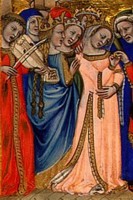
Veils for the bride were often worn- but this was part of her
usual clothing and not particular to the wedding itself. Shown
at right is detail from the 1350s, The Marriage by Nicolo
da Bologna. The bride wears her best dress and is accompanied
by musicians and female friends or relatives.
The language of love stated
that green was the colour of young love and blue was the traditional
symbol of purity, making these two colours a popular choice with
brides. Dresses of white, a colour associated with mourning, were
almost never worn.
Traditionally, a band of blue ribbon would be worn by the bride
and groom, giving us the origins of something blue. Garters
were worn by every woman as part of her daily clothing to keep
her hose fastened securely just under the knee. These became an
important part of a bride's outfit as at the end of the evening
when the couple departed for the bedchamber, guests would try
to take the garter for good luck.
A man who gave his beloved the garter of a bride was said to have
assured her ongoing faithfulness.
Wedding
rings
Wedding rings have been worn for hundreds of years, and the medieval
period was no different.
 The
plain wedding band can be traced back to the 11th century where
it was worn on the third finger of the right hand. Only in the
16th century, was the ring changed to the left. The
plain wedding band can be traced back to the 11th century where
it was worn on the third finger of the right hand. Only in the
16th century, was the ring changed to the left.
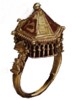
Wedding rings from within the Jewish community tended to be far
more flamboyant than those worn by the rest of the community.
The ring at the left is from Colmar, France and is a Jewish marriage
ring dated around 1300AD. Other rings might be plain or be inscribed
with mottoes of love and fidelity both on the inside and outside.
Marriage
brooches
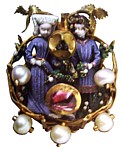 A
marriage brooch was sometimes worn given by the husband to his
new bride. Johannes de Hauville wrote: A
marriage brooch was sometimes worn given by the husband to his
new bride. Johannes de Hauville wrote:
My bride shall wear
a brooch, a witness to her modesty and a proof that hers will
be a chaste bed. It will shut up her breast and thrust back
any intruder, preventing it's closed approach from gaping open
and the enterence to her bosum being cheapened by becoming a
beaten path by any traveller, and an adulterous eye from tasting
what delights the honourable caresses of a husband.
Pictured at right is a Marriage
Brooch dated at around 1430 from the Vienna Kunsthistorisches
Museum. It is made of gold, enamel and precious stones and probably
comes from Germany or Burgundy.
Betrothal
and engagement
Medieval betrothal was almost as legally binding as marriage.
In the case of nobles, betrothals could be arranged at the age
of reason, seven years old, but were not legally binding until
the couple came of age.
It was not unusual for the betrothed couple to have not met until
their wedding day many years later- the most important goal of
marriage between nobles being the acquisition of wealth and to
produce suitable legal heirs.
 In
adult couples of non noble birth, it was not entirely unusual
to cohabit prior to the wedding ceremony and offspring conceived
and birthed during this period could often be legalised at the
wedding ceremony. In
adult couples of non noble birth, it was not entirely unusual
to cohabit prior to the wedding ceremony and offspring conceived
and birthed during this period could often be legalised at the
wedding ceremony.
Hand-fast was a term used for a marriage contract or betrothal
contract which denoted commitment but without the religious ceremony.
This was usually a custom in the very early middle ages and between
the poor. As the influence of the church grew, it became less
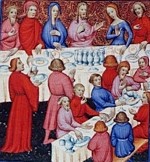
frequent. Pictured at left is the Marriage Feast at Canna 1405-15.
Legalities
of marriage
There were certain times of the year when marriages could not
be performed; the weeks of Lent and Advent due to those times
being religious observances.
For the nobility and the
wealthy, grooms were often significantly older than their brides,
who could be as young as 13 or 14. Noble women occasionally had
the option of not wedding for the first time until the age of
24, but this was a slightly less common.
Rich orphans, female heiresses and wealthy widows often became
wards of the king, and these women or girls could be married to
men of the court who wished to increase their wealth and lands.
A lord could sell his ward's marriage to the highest suitable
candidate to compensate for his own loss of her income.
It was not until the Magna Carta that this practice was
somewhat curtailed although by no means desisted completely. A
law book from the reign of Henry II of England proclaimed:
Even if a female heir
is of age, she shall remain in the wardship of her lord until
she is married according to the desire and with the consent
of her lord... and if a girl... marries without the consent
of her lord, by the just law and custom of the realm, she shall
lose her inheritance...
The peasants and working
classes tended to marry into their own age and status demographic,
preferring to choose healthy women who would bear children well
and be fit enough to work alongside him if needed, as well as
manage the domestic household. The Lord's permission needed to
be sought before a marriage could take place and if marrying outside
of his holdings, a fine or merchet may be exacted.
 More
than 75% of the population were married before the age of 19 although
amongst peasant men, sometimes a son did not marry until the death
of his father where he inherited his fathers assets which put
him in a position to marry. More
than 75% of the population were married before the age of 19 although
amongst peasant men, sometimes a son did not marry until the death
of his father where he inherited his fathers assets which put
him in a position to marry.
Wedding contracts were usually drawn up with particular regard
to the bride's dowry and it's inheritance rights in the event
of her death. Inheritance and property were two reasons why arranged
marriages were contracted at such an early age, although sometimes
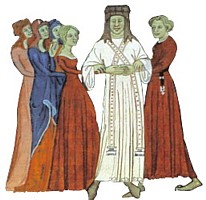
an proposed merger of families was to form an alliance. Shown
at right is a detail from a 13th century manuscript.
A woman had the right to
refuse an arranged marriage by buying her way out of the betrothal
contract, however this was often a sum beyond the reach of the
average woman unless she sold her worldly possessions. In 1207,
this sum was set at a hefty 20 marks for widows and substantially
more for women to remain single or have the right to choose their
own husbands.
This would leave a woman in a state of being financially unable
to support herself and so the marriage went ahead. There are records
of women who did successfully escaped arranged marriages. It is
recorded that:
Quenild, daughter of
Richard FitzRodger owes 60 marks and 2 palfreys that she may
be able to marry whomever she pleases, with the advice of her
friends, as long as she marries no one who is an enemy of the
king.
Records show that although
some women took their husband's surname as their own, not all
did. In the case of heiresses, the groom took the name of the
wife, thus keeping the traditional family holdings in the same
family name.
One sample of this is the case of the remarriage of Sarah, the
widow of Robert le Wyte. Her second husband was afterwards known
as Gilbert le Wyte.
Virginity
tests
In many cases, securing a good marriage was dependant on the bride
remaining chaste until her wedding night, and it was not unknown
for the bride to undertake a virginity test to assure her future
husband of her purity.
Konrad von Megenberg wrote of a test in use in the 14th century.
The girl was required to drink water which had been steeped with
black amber for three days. If the bride to be could not hold
her own water, it was thus proven that she was not pure. The test
does not specify how long the bride was required to hold.
Although a woman might have not remained a virgin, she could consult
a specialist who could advise her how to appear as if she was.
A number of remedies for this were available, one involving leeches
applied in her most intimate parts. Do not try this at home.
Wedding
customs
The custom of throwing money over the heads of newlyweds is documented
in the Warderobe accounts of Edward II. It tells of a wedding
in February 1321, where
money to the value of
£2 was thrown by the King's order at the door of the King's
chapel, within the manor of Havering-atte-Boure during the solemnization
of the marriage between Richard, son of Edmund, Earl of Arundel
and Isabella, daughter of Sir Hugh Le de Spencer, junior.
Upon the announcement of
the betrothal, it was often customary for the bride to receive
a ring with both names engraved on it and for the groom, a sleeve
from her dress or a stocking. These were both intimate gifts,
a hint of things to come and highly prized.
 The
best man at a wedding was exactly that- the best swordsman
that could be found or hired by the groom to ensure the wedding
was not interrupted. It was not unusual for the best man to be
hired and not a relative or friend. The
best man at a wedding was exactly that- the best swordsman
that could be found or hired by the groom to ensure the wedding
was not interrupted. It was not unusual for the best man to be
hired and not a relative or friend.
For those of noble class,
the wedding procession to the church was often accompanied by
minstrels. The order of the procession depended on which family
was the wealthiest- the bride preceded if her family was higher
ranked with the groom and his family behind or vice-versa.
The custom of placing a child in a bride's arms to wish her fertility
and a gold florin in her shoe to bring financial prosperity could
also be performed after the wedding service. In the case of the
15th century wedding of Margery Rygon and George Cely, three live
rabbits were let loose as a gesture of fertility for the bridal
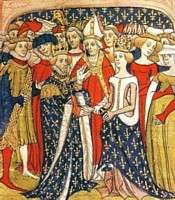
couple. The illumination detail at left (above) is from the 14th
century, Maria of Brabant Marriage.
Handfasting
Handfasting was an very early type of betrothal or trial marriage
which lasted for a year and a day. If the marriage wasn't working
out, the marriage might be annulled and both parties free to marry
again.
This was dependant on no children being born into the marriage.
Handfasting
became an outmoded form of arrangement under the rule of... and
marriages were then to be taken as a more permanent arrangement
from then on. Wives might not be tested out for their trial period,
so to speak.
The wedding
Before the marriage took place, the priest would meet the couple
at the door of the church which had previously been closed to
prevent entry and ask of them the relevant questions. Were they
of age? Did they have parental consent? Were they not related
in a way which would prevent them from wedding in accordance with
the law, that is have a common great great grandparent?
The dowry would be read aloud and the groom would present his
betrothed with a small bag of gold coins to distribute to the
needy. This symbolised his willingness to give her financial management
on his behalf.
There would be a short sermon on the steps, vows exchanged, the
ring placed on the bride's finger, coins distributed by the bride
and then the church doors would be opened for all to enter.
Prayers and a mass were said under a canopy or cloth, then the
kiss of peace was given by the priest to the groom which was passed
to his new wife. Children of the union produced after the betrothal
might be included under the cloth.
The blessing was pronounced and the service itself ended. It must
be noted that although the church considered premarital children
legalised in the eyes of God, lawyers felt otherwise.
The bride's
dowry
The bride's family was responsible for the dowry which, in the
case of the wealthy, was usually money and land holdings.
Commoner's dowry would most likely include household utensils,
tools, furniture, clothing and livestock.
If the husband deceased or the marriage was annulled, the dowry
reverted to the bride. This would then be passed down to her sons.
If the widow remarried, the dower reverted back to the husband's
remaining family.
Wedding
feasts
The wedding feast was often a lavish affair with many specialty
dishes.
Francesco
Datini, a wealthy Italian businessman married Margherita on the
week of Carnivale and the wedding feast included: 406 loaves,
250 eggs, 100 pounds of cheese, two quarters of oxen and 16 of
mutton, 37 capons, 11 chickens, 2 boars heads and feet for jelly,
an unspecified number of pigeons and waterfowl, local provincial
wines and Chianti imported from Tuscani.
While this was quite a feast by regular standards, it was quite
modest compared to those given by royalty at the times of their
own weddings.
If a couple were poor, they
might be treated to a bride-ale by their family and other well-wishers.
Guests would not only bring food for the feast itself but often
assist with goods and money to help them set up house. Shown at
right is a detail from an illumination, 1405-1415, Marriage
Feast At Canna.
Wedding
gifts
It was usual for at least three wedding gifts to be exchanged
by the bride and groom themselves. The bride's dowry was supplied
by the bride's parents, guardian or her benefactor. A large dowry
made a woman more attractive as a potential wife if she was otherwise
not as comely as others. In this instance, a bride was seen more
as a prize than a beloved.
It was also traditional
for the groom to give a present to his new wife after the marriage
was consummated to compensate the for the loss of virginity. This
could be any number of items, including small and valuable pieces
of furniture.
The groom or his family was responsible for providing a suitable
home including income, although in many cases the groom would
have been working alongside his father in a family business or
trade for a number of years prior to his nuptials.
Gifts would be given to the
couple only after the ceremony has taken place, usually at the
marriage feast. Guests would often also receive a small gift from
the couple which reflected the status of the guest, not of the
couple.
A gift would also be given to the priest who performed the ceremony.
 Flowers Flowers
Did medieval brides carry boquets of flowers like we do today?
Which flowers were preferred?
Lilies and roses were popular choices for weddings and would be
strewn on the floor among the rushes at the marriage feast. The
guests would release the fragrance of both as they trod on them
underfoot.
Carrying a bouquet of flowers does not appear to have been a medieval
tradition as far as I can tell, although they may have been worn
as a chaplet in the hair by less affluent women.
Rosemary, rosmarinus officinalis, symbolic of memory and
fidelity, was used in wreaths for marriages.

Copyright
© Rosalie Gilbert
All text & photographs within this site are the property of
Rosalie Gilbert unless stated.
Art & artifact images remain the property of the owner.
Images and text may not be copied and used without permission.
|