|
fabrics
& sewing
sewing
tools
sewing
techniques
basic
medieval
clothing
sewing
tutorials
commercial
patterns &
what to do
about them
dyes
&
colours
fabric,
fur
& leather
names
embellishments
& embroidery
buttons
& lacings
|

Medieval
Fabrics & Sewing
CLOTH WIDTHS - THREADS - MARKING CLOTH FOR PATTERNS
- WEAVES, BROCADE & DAMASK DESIGNS KNITTING
LINENS - WOOLS - SILKS - VELVETS - HEMP - COTTON - TIRETAINES
- FUSTIAN
 The
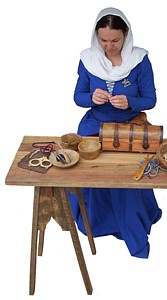
construction pattern of most medieval clothing did not
differ between a woman of small means and a woman with a large
budget. How the clothes went together was essentially the same.
What really set the classes apart, was not the quality of workmanship,
but the quality of the fabric from which garments were
made. The
construction pattern of most medieval clothing did not
differ between a woman of small means and a woman with a large
budget. How the clothes went together was essentially the same.
What really set the classes apart, was not the quality of workmanship,
but the quality of the fabric from which garments were
made.
All of the clothing was hand stitched, and there is no reason
to believe that a woman living in the country was less capable
of wielding a needle and thread than her city counterpart. Both
women might use wool to make a kirtle, but the city woman's fabric
would be substantially finer and have richer colours than a woman
who lived in the country.
Even naturally dyed clothing could be relatively colourful, and
while laws prohibited some colours to some classes, a poor woman
could avoid looking dowdy by good use of mixing of colours for
her wardrobe, limited though it may have been. This page takes
a look at sewing and making basic medieval dresses.
For more information on patterns from existing clothing, visit
the clothing section on the links
page.
FABRICS AND SEWING
Scroll down for a look at cloth widths, marking patterns out,
medieval fabric self-patterned weaves and brocade designs.
SEWING
TOOLS
Scissors, needles, thimbles, irons etc. Tools in a woman's sewing
kit.
SEWING
TECHNIQUES & TUTORIALS
Stitches, seams, eyelets and how they went together.
- EYELET MAKING
TUTORIAL - How to make eyelets
- BUTTONHOLE
MAKING TUTORIAL - How to make buttonholes
- CLOTH BUTTON
MAKING TUTORIAL - How to make buttons to match your clothes
- LUCET CORD
TUTORIAL - Making lacing cord for your gown
BASIC
CLOTHING PATTERNS & TUTORIALS
How to construct your own medieval patterns!
- EASY
T- TUNIC TUTORIAL - How to make a basic medieval gown
- EASY 13TH CENTURY
TUNIC TUTORIAL - How to make an overgown with short, wide
sleeves
- EASY WIDE-SLEEVE
GOWN TUTORIAL - How to make an overgown with really big
sleeves
- BASIC
EASY LACED GOWN TUTORIAL - Basic gown with front or back
lacing
- KIRTLE OR GOWN
TUTORIAL - How to make a medieval dress with buttons
- LADIES HOSE TUTORIAL
- How to make hose based on the London hose pattern
- EASY EARLY
HOOD TUTORIAL - How to make an early medieval hood
- HOOD WITH SHOULDER
GORES TUTORIAL - How to make a 14th or 15th century hood
- BASIC SURCOTE
TUTORIAL - How to make a surcote with 4 seams
- SIDELESS
SURCOTE TUTORIAL - How to make a sideless surcote with gores
- FORMAL
SIDELESS SURCOTE TUTORIAL - How to make a noblewoman's sideless
surcote
COMMERCIAL
PATTERNS & WHAT TO DO ABOUT THEM
A look at some commercial patterns and how to adapt them.
DYES
and COLOURS
Dyestuffs, dyeing and colour names
FABRIC,
FUR & LEATHER NAMES
Those referred to in documents and their descriptions.
EMBELLISHMENTS
& EMBROIDERY
Spangles, pressed metal and gauffres, jeweled bands and embroidery.-
on clothing.
BUTTONS
and LACINGS
LINEN
IN THE 14TH CENTURY
A compliation of notes from shared sources.
Cloth widths
The width of a horizontal loom governed the size of fabric which
was available. The most common measurements for cloth were the
yard (the length of an outstretched arm), the nail (two and a
quarter inches wide) and the ell.
 Of
these, the ell was the most common length used for the measurement
of cloth. In England, this distance was usually 45 inches if the
cloth is English. If it is Flemish, an ell measured 27 inches.
If Scottish, an ell measured 37.2 inches. Of
these, the ell was the most common length used for the measurement
of cloth. In England, this distance was usually 45 inches if the
cloth is English. If it is Flemish, an ell measured 27 inches.
If Scottish, an ell measured 37.2 inches.
This difference in measurements must surely have caused serious
issues between importers and exporters of cloth and is possibly
why the yard and inch persist today and the ell does not.
Although these were fairly standard measurements for regular cloth
production, it was possible to produce woven fabric of larger
sizes for special commissions. In 1304, two women wool merchants,
Aleyse Darcy and Thomasin Guydichon, are recorded as having sold
to the Earl of Lincoln:
...one piece of cloth,
embroidered with diverse works in gold and silk.. eight ells
(thirty feet) in length and six ells (twenty-four feet) in breadth...
for the huge sum of 300 marks.
It doesn't record what the cloth's intended use was, but it does
give us an idea of the possible size of cloth manufacture at that
time.
Some looms which required two workers permitted fabric to be made
in lengths up to 30 metres and as wide as two metres, although
this was not the general standard for clothing. The fulling process
required to produce certain fabrics reduced the width of most
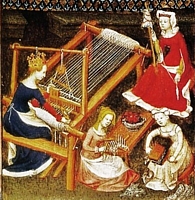
material to about a metre and a half. Shown above is an illustration
for clothes from the 14th century manuscript, Tacuinum Sanitatus
showing the stages and processes of cloth production.
Threads
Generally, for the bulk of the medieval period, the most common
thread used for sewing garments by far was linen. Raw cotton was
imported and used for a variety of purposes in England, but although
it was used plied for candle wicks, it seems it was not used for
sewing.
Some existing stitching in hems may be flax. Silk thread was used
extensively for silkwork and in some cases, for sewing woolen
clothing, for buttonholes and and eyelets. It is probable that
linen threads were used for the main seams and the silk threads
used for visible stitching or decorative stitching as there are
indications that both types of thread are used on a single garment.
Commonly mentioned silk threads are white, black, yellow, blue,
green, red, flame and purple. In the Museum of London Series,
Textiles and Clothing by Crowfoot, we read that although
linen is harder to dye and was likely to be used undyed where
it could not be seen internally, coloured linen threads were used:
"The linen thread
supplied to the Great Wardrobe in the 1330s cost between 2s.
and 2s.8p. per lb and came not only in different thicknesses,
but also in a variety of colours."
There are examples of woolen
thread being used for stitching in lower classes both overseas
and in England.
Marking
cloth for making patterns
The Goodman of Paris gives this recipe for making a
liquid for marking linen.
Take axle grease (the
dirt at both ends of an axle tree of a wagon), add ink, combine
oil and vinegar, and boil all this together. Then heat your
marker, moisten it n this mixture, and set it on your linen.
It seems unlikely to me to
wash out afterwards, and I don't know why, if ink is one of the
ingrediants, it was not just used watered down by itself. It is
also possible that this is a recipe for block printing on cloth.
Self-patterned
weaves, brocades and damask designs
Fabric was often woven into brocades and geometric designs. Diamond
and square patterned cloths known as diaper were woven from silk,
linen and in some areas, cotton. The fabric pattern was woven
in a one colour only.
With linen, there is a large amount of evidence for being woven
into a number of designs for use on table cloths, towels, napkins
and pillowcases. These self-patterned weaves were single colour
and several existing examples have been found in London, as early
as 10th century in York. The earliest record of self-patterned
linen is the shroud of St Bathild who dies in 680AD in Northern
France but other fragments from Anglo-Saxon burials also include
designs like lozenges and herringbone.
 Damasks,
rich patterned heavy material of silk or linen featured cloth
which the pattern appears reversed on the back of the fabric.
Intricate patterns of brocaded silk were a feature of silk velvet
on velvets. The artichoke cynara scolymus was grown plentifully
during the medieval period and was featured in many medieval fabric
designs from the 13th to 15th centuries. Damasks,
rich patterned heavy material of silk or linen featured cloth
which the pattern appears reversed on the back of the fabric.
Intricate patterns of brocaded silk were a feature of silk velvet
on velvets. The artichoke cynara scolymus was grown plentifully
during the medieval period and was featured in many medieval fabric
designs from the 13th to 15th centuries.
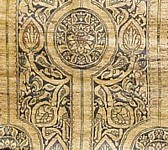
Other patterns featured repeated
designs within circles and teardrop shapes with flowers and animals
within. A beautiful example of this is the silk woven with gold
thread patterned silk, at left, from Sicily dated at between 1325
and 1350. It belongs to a garment often referred to as St Elizabeth's
Cloak.
Knitting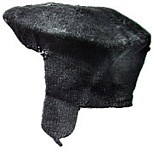
Very early examples of single-needle knitting known as nahlbindning
are found throughout Europe during the pre-medieval period. This
is not the kind of knitting we are looking at here.
Examples of knitted items have been found in the medieval period,
although not many are complete. Shown at right is a knitted woolen
cap from the Museum of London. It was found in a London deposit
dated before or around 1500. There are a few other examples of
two-needle knitting from early England- gloves, vests and caps.
Most of these appear to be the same stocking stitch we use today.
In a late 14th century altarpiece, Mary is depicted knitting,
although in her essay Weaving and Gender Division of Labour
in the Middle Ages, the author Ruth Karros asserts that knitting
was, in fact, a craft which was restricted to men. 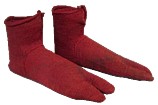 I
would imagine that like many of the other regulated town crafts,
this did not apply to the country woman who did her own clothing
production at home. I
would imagine that like many of the other regulated town crafts,
this did not apply to the country woman who did her own clothing
production at home.
Shown at left is a pair of
red socks which are housed in the V&A Museum. They are dated
somewhere about 300-500 AD, are in good repair and have no moth
holes. Image used with kind permission of Amanda and Jane at THEWOMANSROOMBLOG.
While this is substantially earlier than the medieval period and
uses the single needle technique of nahlbindning, it shows
that the skill of knitting items such as socks was known at that
time. These particular socks would have been worn with a sandals
like the ones we have today.
Linens
Information from the Tacuinum of Vienna describes linen
clothing thus:
The nature of linen
is cold and dry in the second degree. It's optimum is light,
splendid and of the beautiful kind while it is described as
useful to moderate the heat of the body. The dangers of linen,
however, are that it presses down on the skin and blocks transpiration.
 In
order to neutralize the dangers of wearing linen, one was instructed
to mix it with silk. The effects were described as drying up ulcerations
and primarily good for hot temperaments, for the young, in summer
and in the southern regions. In
order to neutralize the dangers of wearing linen, one was instructed
to mix it with silk. The effects were described as drying up ulcerations
and primarily good for hot temperaments, for the young, in summer
and in the southern regions.
As with most other fabrics,
linen came in varying degrees of quality and fineness, from thick
opaques to the very fine. The quality varied for its intended
use and the status of the wearer. Linens were used for bedding,
napery, underclothing, lightweight summer clothing and veiling.
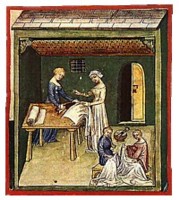
The image shown at right comes from the Tacuinum Sanitatis.
Processing the flax into
fibres, weaving and finishing was primarily done in rural areas.
By the mid-14th century, the development in looms enabled workers
to produce a much longer fabric woven all in one piece, which
required great skill and was prized. In the late 14th century,
Flemish linens were known as the finest. Some samples of linen
damask show a thread count of between 60 to 200 threads per inch,
making them suitable for fine veiling.
At times plain, undyed linen thread was used for sewing, but there
are records of dyed linen thread being used for sewing. In the
Museum of London book, Textiles and Clothing, information
about linen thread says:
The linen thread supplied
to the Great Wardrobe in the 1330s cost between 2s. and 2s.8p.
per lb and came not only in different thicknesses, but also
in a variety of colours.
Wools
Wool was the staple of medieval clothing for all classes- the
quality varying hugely between the worsted fabrics of the poor
to the very fine wools produced in England which were exported
to Europe. Wool was weighed by the tod, which was usually
measured at 28lb, although this was liable to local variation.
The standard sack of wool for export was 364 pounds, and it was
calculated that approximately 240 sheep were needed to provide
the wool required for one sack.
By the 13th century, there were about 50 different grades of wool.
Woolen clothing and its properties are discussed in the medieval
text Tacuinum Sanitatus of Casanatense as:
having a warm and dry
nature, the optimum kind being "the thin kind from Flanders."
It's usefulness is it protects the body from cold and holds
warmth although its dangers were that it causes skin irritation.
 Neutralization
of the dangers of wool were advised by the wearing of thin linen
clothing, presumably underclothing, worn between the wool and
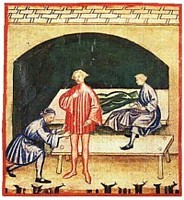
the skin. Shown at left is Wool, from the Tacuinum Sanitatus. Neutralization
of the dangers of wool were advised by the wearing of thin linen
clothing, presumably underclothing, worn between the wool and
the skin. Shown at left is Wool, from the Tacuinum Sanitatus.
By the 13th century, Italian
woolens and cottons were being sold internationally and there
was an estimated eight million sheep in England alone. By the
second half of the 14th century, Paris was at the very top of
the field in the production and export of middle range woolens
called biffes.
Wools produced in Flanders in the 14th and 15th centuries became
better and eventually rivaled the English ones for quality. The
shorter the woolen fibre was, the tighter the weave and the heavier
the finished cloth would be. The difference between better woolens
and the lesser worsteds was essentially in the fulling and finishing.
After fulling, the wet woolen cloth was stretched, burls removed,
and the imperfections repaired before being placed over a bar
and then teased before the final shearing. Dry shearing could
be performed by repeated napping and clipping to produce a silky,
smooth finish.
Often woolen clothing was
dyed twice- once in the wool and again in the piece. Prices for
woolen cloth varied depending on the finishing process- the more
times a cloth had been sheared and finished, the more expensive
the cloth was. Because of their expense, wills and bequests often
made particular mention of woolen clothing and specified the worth
of the garment indicating what quality it might be.
In 1313, Anicia atte Hegge, a widow from Hampshire, made a will
on the surrendering of her holding to her son which included the
stipulation that among other things, she would be provided with
various items of clothing including a woolen garment every other
year worth 3 shillings.
Silks
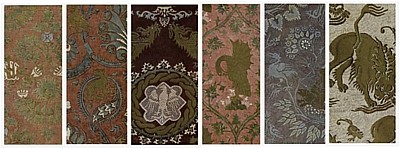 Silks
were expensive in the early part of the Middle Ages but popular
with the wealthy, not only for the fabric's luxurious texture
but its ability to hold dye and produce brilliant colours not
available in other fabrics. Silks
were expensive in the early part of the Middle Ages but popular
with the wealthy, not only for the fabric's luxurious texture
but its ability to hold dye and produce brilliant colours not
available in other fabrics.
Oriental silks were imported from the east and patterned or brocaded
silks are often written about. Unlike other fabric, silks were
almost always sold by the ounce rather than by length.
Shown above are some existing samples of Italian silks from the
mid-to-late 14th century. They show a diverse range of designs,
colours and themes which were probably brighter when new.
In Europe, silks were also locally produced. By the 14th century,
silks from Lucca, Venice, Genoa and Bologna were known to produce
silks of exceptional quality which were much desired by nobility.
Records from 1324 indicate that Paris was producing silk and gold
thread brocades and that English Royal household accounts show
purchases of Parisian silk from the years 1324 to 1333.
Velvets
and velvet blends
Silk velvets were extremely expensive and were a luxury fabric
only for the richest of the rich. They were often brocaded with
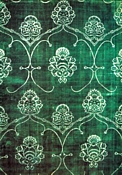
large patterns, often floral. The green, patterned silk velvet
shown at right was made in Venice in the late 15th century and
features an artichoke design. It is interesting to note that the
artichoke was believed to have strong aphrodisiac powers and one
wonders if wearing artichokes was hoped to invoke the same feelings
of desire to the wearer.
 Velvet
was produced with either simple or compound weaves being elaborated
by introducing a supplementary warp over a series of very small
rods. The rods are removed leaving small loops, which can be shorn
or left as loops which form the velvet pile. Both simple and compound
velvet weaves can be enriched by sets of yarns on the surface
of the cloth which produces a brocade. Velvet
was produced with either simple or compound weaves being elaborated
by introducing a supplementary warp over a series of very small
rods. The rods are removed leaving small loops, which can be shorn
or left as loops which form the velvet pile. Both simple and compound
velvet weaves can be enriched by sets of yarns on the surface
of the cloth which produces a brocade.
Mustyrdderyllers is known to be a 15th century cloth from
Muster-de-Villiers. It is suggested that the name may also be
derived from mestier de velours meaning half-velvet- similar
to velveteen.
Archaeological evidence exists of a garment in which King Philip
1 of France was buried, was constructed of woolen velvet. It is
dated at 1108. A further reference to woolen velvet comes from
a study of velvet production in the early middle ages from Tournai
in 1380. According to research by Lydie LaBarthe:
fragments of twill and
cotton velvet have been found dating back to 9th century in
France. The textile known as pile on pile or double velvet is
also one of the oldest known velvet weaving techniques. Three
dimensional textiles with looped or cut pile are supplementary
weft compound weaves. As early as 2000BC the Egyptians made
linen fabrics with extra linen weft pulled out into loops for
both effect and warmth.
Hemp
Hemp was cultivated for cloth production in the middle ages. There
are several references to crops of hemp which were to be harvested
for textile use.
One such reference comes from Christine de Pisan in Le Livre
des Trois Vertus. She writes of the duties of an aristocratic
wife and says that while such a wife may not actually do any of
the weaving in her household herself, she must be knowledgeable
about every facet of the process so that she may oversee each
and every stage of the process- from the selection of the fleeces
to the final construction of finished garments. She adds specifically:
..she will have her
tenants grow hemp that her chambermaids will spin and weave
on winter evenings.
Cotton
It appears that clothing made of cotton or cotton/linen and cotton/silk
blends was not entirely unknown, although the production of cotton
is specific to certain time periods and countries. From the 7th
to the 13th century, cotton and cotton/silk blends came out of
the far east. Merchants in Egypt exported flax, dyes and cotton
fibres. It is not unusual during that period to see references
in Europe to clothing made entirely or partially of cotton.
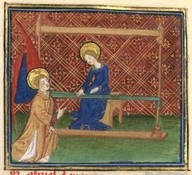 During
the 13th century, according to Mazzaoui's publication the Italian
Cotton Industry, the manufacture of cotton items in northern
Italy rivaled wool in the numbers of workers it employed. The
cloth produced was of medium weight and used for undergarments,
bedding and summer clothing. During
the 13th century, according to Mazzaoui's publication the Italian
Cotton Industry, the manufacture of cotton items in northern
Italy rivaled wool in the numbers of workers it employed. The
cloth produced was of medium weight and used for undergarments,
bedding and summer clothing.
According to Piponnier & Mane's Dress in the Middle Ages,
in Northern Italy, Spain and Southern Germany, it was often mixed
with hemp or linen to form an expensive twill fustian. Another
source, Ibed, speaks of cotton clothing and blankets, flannelettes
and quilted cottons which competed with coarse linens. It should
be mentioned, however, that Italians did not produce luxury cotton
fabrics, prints, tapestry weaves or brocades for clothing.
Frances and Joseph Gies,
in their book Cathedral, Forge and Waterwheel, Technology and
Invention in the Middle Ages discuss weaving of cotton and
go on to say that during the 14th century, the use of cotton spread
throughout the continent and Europe for use as coifs, veils, wimples,
handkerchiefs, purses and clothing linings. There seems to be
no reference to cotton clothing in England at these times.
Tiretains
Tiretains were produced with a linen warp and woolen weft. It
was commonly believed to be a fabric which was low-priced and
lightweight- a fairly popular fabric for those of low status.
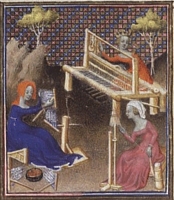 Recent
research suggests that tiretains were bought and used by nobility
and royal household accounts show the purchase of it also for
clothing, indicating that some tiretains were not as rough as
we used to believe or that like wool, tiretains were produced
in varying degrees of quality. It appears to have been used for
lightweight summer clothing, usually lined with silk and in one
instance, lined with fur. One assumes that silk linings were not
used in conjunction with a low-cost fabric popular with the lower
classes. Recent
research suggests that tiretains were bought and used by nobility
and royal household accounts show the purchase of it also for
clothing, indicating that some tiretains were not as rough as
we used to believe or that like wool, tiretains were produced
in varying degrees of quality. It appears to have been used for
lightweight summer clothing, usually lined with silk and in one
instance, lined with fur. One assumes that silk linings were not
used in conjunction with a low-cost fabric popular with the lower
classes.
In one record of the 1315
accounts of the Mahaut of Artois, there is a mention of tiretain
being purchased at 26 ounces, also indicating that silk was an
ingredient of that particular piece of fabric. It is speculated
that in that particular example, the silk may have replaced the
linen warp.
It appears also that kermes,
an extremely expensive dye, was used to dye tiretain. In 1268,
two kermes-dyed tiretains were purchased for the English king.
In 1328 the widow of Louis X owned an outfit of black tiretain,
also dyed with kermes.
When the French Queen Clemence of Hungary died, it was noted that
4 of her 35 garments were of tiretain of different colours and
her husband the King had a coat also lined with tiretain. A dye
as expensive as kermes would not have been wasted on a fabric
which was not of a suitably high quality, and the fact that it
was purchased for king's clothing also indicates that the quality
of the fabric was far superior to the rough fabric it was previously
supposed to be.
Fustian
Fustian appears to be constructed in the same way as velvets,
being described as a coarse twilled cotton cloth sometimes made
with a linen warp and cotton weft, woven in the same way as velvet
and with a sheared surface. As mentioned above, Piponnier &
Mane's Dress in the Middle Ages, in Northern Italy, Spain
and Southern Germany, states that cotton was often mixed with
hemp or linen to form an expensive twill fustian used for making
doublets, outer summer clothing and winter underwear.
The word fustian can be found in records as early as the 11th
and 12th centuries and is associated with heavily wefted materials,
especially those with weft floats that could be cut to produce
pile. Fustian was made in Italy, Spain, Germany and Holland and
was first mentioned in England in 1114.
Copyright
© Rosalie Gilbert
All text & photographs within this site are the property of
Rosalie Gilbert unless stated.
Art & artifact images remain the property of the owner.
Images and text may not be copied and used without permission.
|
